What is the best Spiti Valley itinerary? A 9-day Spiti Valley circuit from Delhi enters via Shimla and Kinnaur, spends 3 nights in Kaza, and exits via Chandratal and Manali. Key stops are Reckong Peo (night 2), Nako (night 3), Tabo and Dhankar (day 4), Kaza as base (nights 4 to 6), Chandratal (night 7), and Manali (night 8). The winter itinerary follows the Shimla route only, takes 6 to 7 days, and focuses on Kaza, Key Monastery, and Kibber for snow leopard sightings.
Most Spiti Valley itineraries online are written by people who have researched the route, not stood at Kunzum La at 7 AM when the first light touches the passes and your hands are too cold to hold a camera but you cannot stop smiling. This Spiti Valley itinerary guide is different. The altitude numbers here are the same as everywhere else. The distances look reasonable too. And then you actually get there and realize the 50 km between Nako and Tabo feels completely different from any 50 km you have driven before, because the Malling Nala section will make you grip the steering wheel with both hands while the Spiti River moves 400 metres below your tyres.
That gap between what an itinerary says and what a route actually feels like is the difference between a trip that lands well and one that catches you off guard at 14,000 feet with a headache and a budget that ran out in Kaza. This guide closes that gap. It covers the summer circuit in full, the winter version in honest detail, and the specific things each day asks of you physically and logistically, not just where you go but why you go there in that order.
For context on when each of these itineraries actually works and what crowd levels look like month by month, The Travel Story’s Spiti Valley seasonal guide is built from on-ground experience across every month of the calendar year.
What to Know Before Planning Your Spiti Valley Itinerary
Fact 1: Spiti has two different road seasons, and they determine everything.
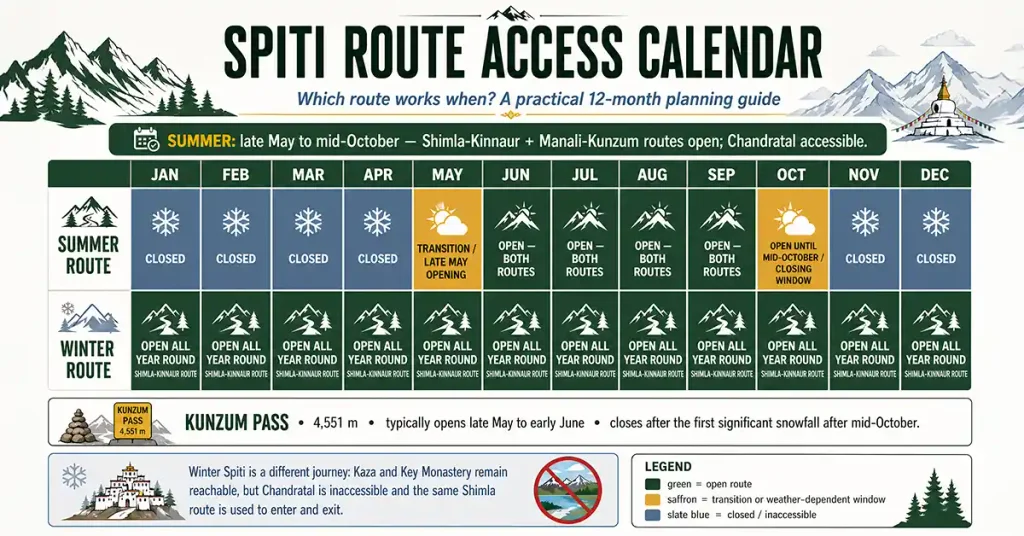
The Shimla-Kinnaur route stays open year-round for most stretches, though winter requires a 4WD and careful road monitoring. The Manali route via Kunzum Pass (4,551 m) is open only from late May to mid-October. This means your circuit options are:
- Summer (late May to mid-October): Both routes open. You can enter via Shimla and exit via Manali, or the reverse. Chandrataal is accessible.
- Winter (November to late May): Shimla route only. Kunzum Pass is buried in snow. Chandrataal is inaccessible. Kaza and Key Monastery are still reachable.
Fact 2: The Shimla route is the correct first-timer route — not the Manali route.
The Shimla route gains altitude gradually over 2 to 3 days: Narkanda at 2,700 m, Reckong Peo at 2,670 m, Nako at 3,625 m, then Kaza at 3,800 m. Your body adjusts in stages. The Manali route via Kunzum Pass pushes you from Manali at 2,050 m to Kaza at 3,800 m in a single driving day. That speed of ascent is the most common reason first-time visitors arrive at Kaza with a splitting headache and spend their first full day doing nothing useful.
The 9-Day Spiti Valley Itinerary: Full Summer Circuit (Shimla In, Manali Out)
This is the route that delivers the most variety, the most landmarks, and the most efficient circuit without backtracking. Shimla in, Manali out, with Chandrataal on the final stretch. For travellers who want this exact circuit managed end to end with a trip captain, backup vehicle, and accommodation pre-booked at each stop, The Travel Story’s Spiti with Chandrataal package runs weekly batches from June through September at Rs 17,999 per person.
Day 1: Delhi to Shimla (350 km, 8 to 9 hours)
Leave Delhi by 5 AM. The road to Shimla via Chandigarh runs on National Highway 5 and is mostly expressway until Kalka, where the hill road begins. Arrive in Shimla by early afternoon, check in, and sleep early. This is a transition day. Do not try to push further. You are crossing from the plains into the foothills, and the altitude of Shimla at 2,220 m is a useful first step in acclimatization.
If leaving Delhi by overnight Volvo from ISBT Kashmiri Gate, you arrive in Shimla in the morning and can proceed directly to Narkanda on the same day, effectively combining Day 1 and Day 2.
Overnight: Shimla or Narkanda Distance: 350 km Altitude gain: 216 m (Delhi) to 2,200 m (Shimla)
Day 2: Shimla to Sangla Valley or Reckong Peo via Kinnaur (230 to 280 km, 8 to 10 hours)
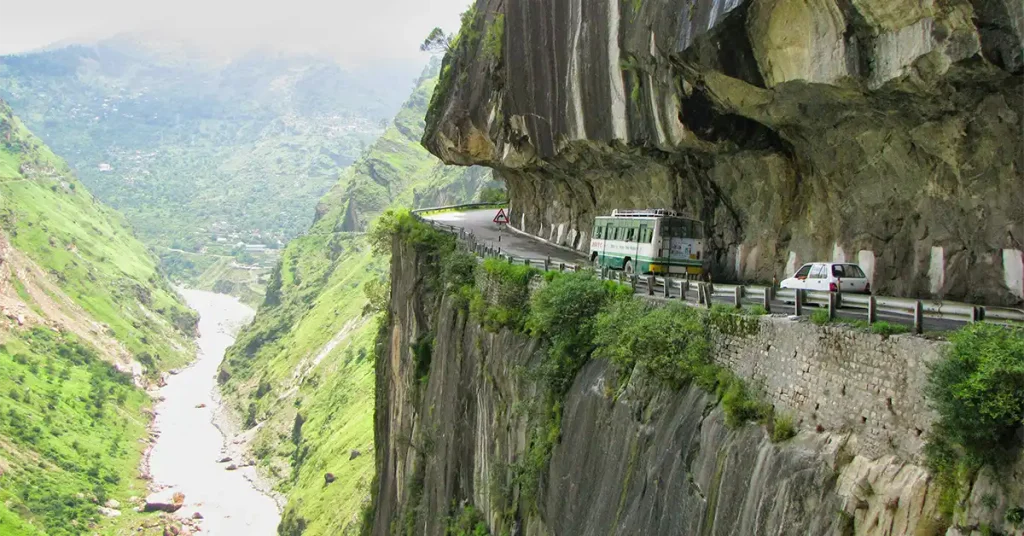
This is where the journey becomes genuinely different. Leave Shimla by 6 AM. The road follows the Hindustan-Tibet Highway along the Sutlej River gorge through Rampur and into the Kinnaur district. From Karcham, you have a choice: detour into Sangla Valley (and optionally Chitkul, India’s last inhabited village on the Indo-Tibet border), or continue straight to Reckong Peo.
The Sangla-Chitkul detour adds 60 km round trip but delivers your first look at the river colors and stone architecture that characterize this part of Himachal. If you have the day, make the detour. If you are running to a tighter schedule, proceed to Reckong Peo and detour to Kalpa for the sunset view of the Kinner Kailash range directly across the valley.
Fill your fuel tank completely in Reckong Peo. There is no petrol pump between Reckong Peo and Kaza on the Shimla-Kinnaur route.
Overnight: Reckong Peo or Sangla (for the Chitkul detour) Distance: 230 to 280 km depending on detour Altitude gain: 2,200 m to 2,670 m
Day 3: Reckong Peo to Nako via Khab Sangam (80 km, 4 to 5 hours)
Short distance, long experience. The road from Reckong Peo descends to Khab Sangam, where the Spiti River meets the Sutlej River in a confluence visible from the road above. The two rivers are noticeably different in color at this point, green-grey Spiti joining the brown Sutlej, and the sight is one of those genuinely underrated stops that people who rush past always regret.
Past Khab, the road crosses the Pooh bridge and begins the climb toward Nako. The Malling Nala section sits roughly 20 km before Nako and is the most unstable stretch on the Shimla route, prone to rockfall and water during monsoon months. Drive through it without stopping and without lingering.
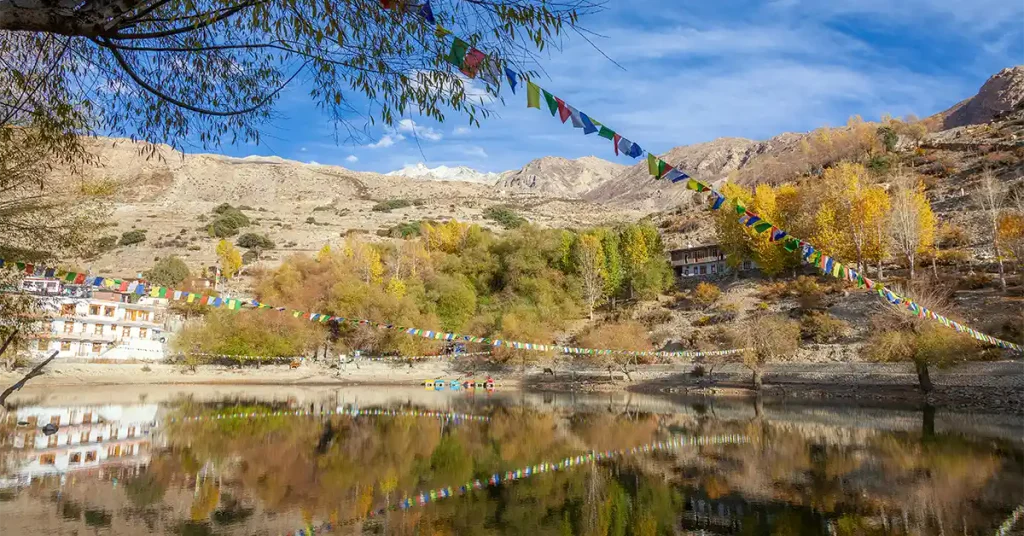
Nako itself is a village at 3,625 m built around a small lake that freezes in winter and reflects the surrounding peaks in summer. The Nako Monastery in the village dates to around the 11th century. Arrive before 4 PM and walk around the lake in the late afternoon light.
Overnight: Nako Distance: 80 km Altitude gain: 2,670 m to 3,625 m Key: This overnight is the most important acclimatization night of the trip. Sleep here, drink water, eat light.
Day 4: Nako to Kaza via Tabo and Dhankar (150 km, 5 to 6 hours)
This day covers the most historically significant ground of the entire circuit.
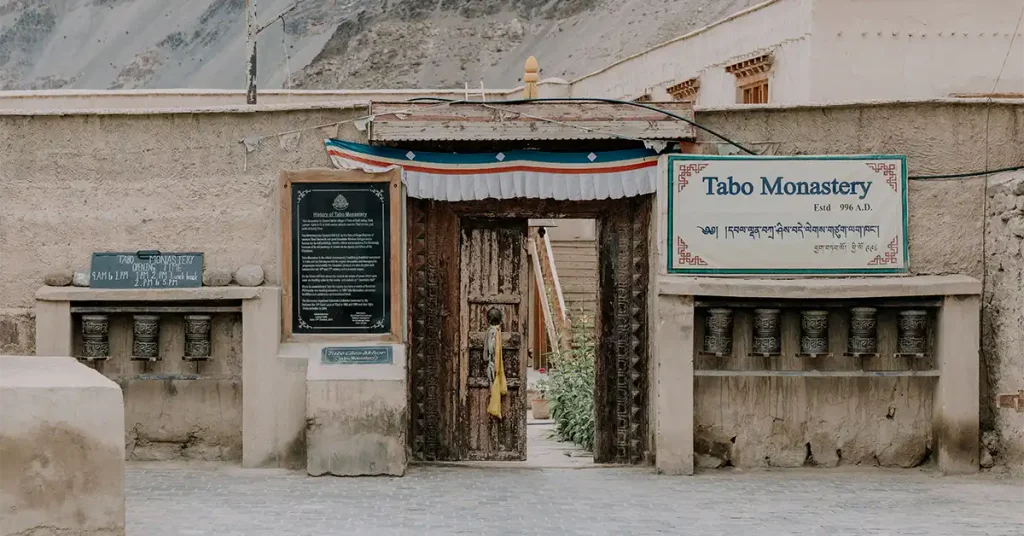
Tabo Monastery (3,050 m): Founded in 996 AD, Tabo is one of the oldest continuously functioning monasteries in the Himalayas. The Dalai Lama has stated his wish to retire here. The 10 temples inside the main complex hold clay sculptures, murals, and manuscripts that have survived 1,000 years of Himalayan winters in a cold desert with zero humidity. Visit the morning prayer session if you can reach Tabo before 8 AM. The Tabo cave complex above the main monastery is a 15-minute walk uphill and worth the extra time.
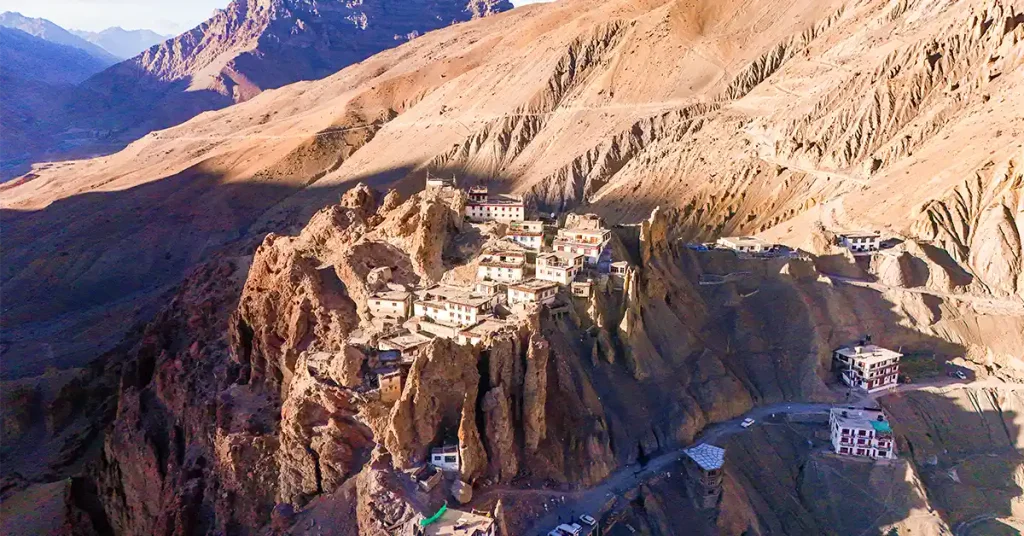
Tabo to Kaza is 46 to 50 km and takes around 1.5 to 2 hours. On the way, the detour to Dhankar Monastery adds 40 minutes but delivers the most dramatic single view in Spiti Valley. Dhankar sits on a crumbling spur 1,000 feet above the confluence of the Spiti and Pin rivers. The monastery looks like it was built there to make a philosophical point about permanence. Walk up to the monastery rooftop, and then continue uphill for another 45 minutes to Dhankar Lake for a view across the entire Pin-Spiti confluence.
Overnight: Kaza (3,800 m) Distance: 150 km Note: Kaza is your base for the next 2 to 3 nights. It is the main town in Spiti Valley with ATMs, cafes, basic medical services, and a market.
Day 5: Kaza Villages Circuit (Key, Kibber, Chicham, Langza) — 60 to 80 km local loop
This is the day most people describe as their best day in Spiti.
Key Monastery (4,166 m): The most photographed building in Spiti for good reason. Over 1,000 years old, built into a hilltop above the Spiti River, and still housing more than 300 monks. The approach road is paved. Arrive early in the morning before tour vehicles from Kaza begin arriving around 10 AM.
Kibber (4,270 m): One of the highest motorable villages in the world. After Key, the road continues to Kibber through a switchback that delivers successive views back across the Spiti Valley floor. Kibber is a working village, not a tourist set-piece. The houses are made from the same brown stone as the surrounding mountains.
Chicham Bridge: Asia’s highest motor bridge, connecting Kibber to the Chicham hamlet across a 150-metre gorge. Walk across it. The depth below is not for everyone, but the structure itself is a significant piece of engineering that replaced a ropeway system that local villagers used for decades.
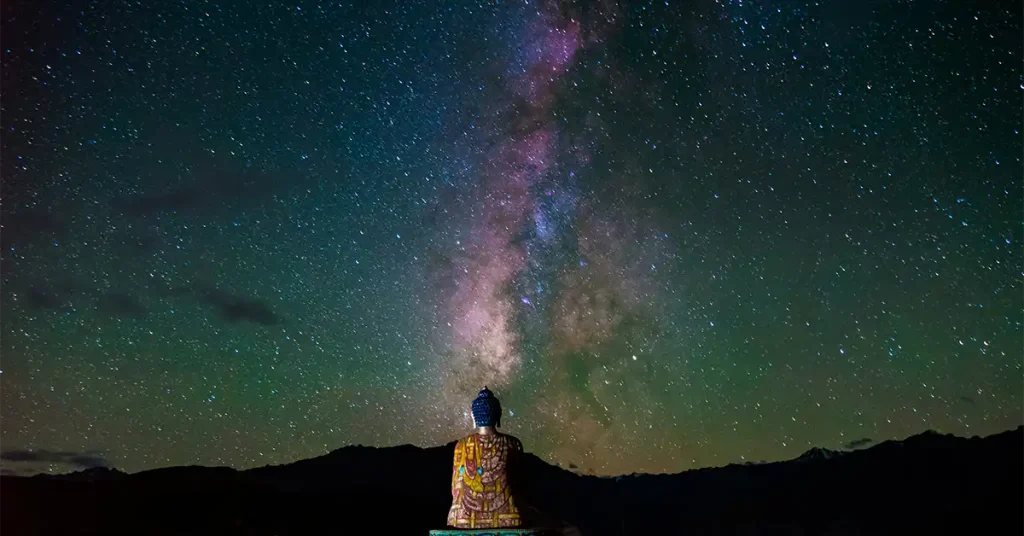
Langza (4,400 m): Known for its Maitreya Buddha statue that looks out over the valley from a stone promontory, and for marine fossils in the surrounding fields. The village sits at a level where the sky is noticeably different from anywhere in the valley below. The marine fossils are genuine: the Spiti Valley was under the Tethys Sea 40 to 50 million years ago, and the sedimentary rock still holds shells and ammonites that you can find lying on the ground.
Overnight: Kaza
Day 6: Komic, Hikkim, and the Upper Village Loop — 50 to 70 km
Hikkim (4,588 m): The world’s highest functioning post office. A letter posted here arrives with a rubber stamp certifying the altitude. This is not tourist infrastructure — it is the actual post office serving Hikkim village, and it has been functioning at this altitude since the Indian Postal Service established it. Open on weekdays.
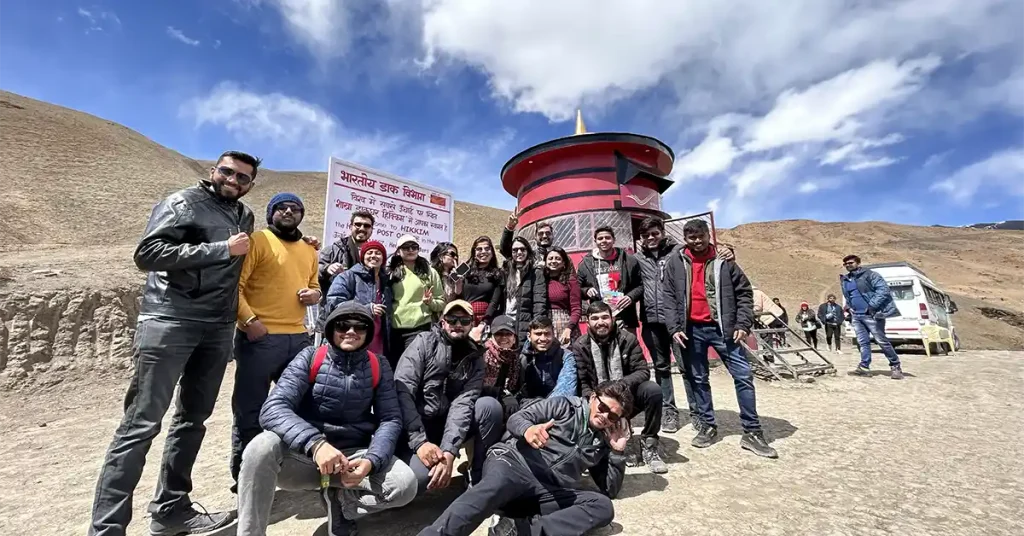
Komic: Often cited as one of the highest motorable villages in Asia. The monastery here, Tangyud Gompa, is built into the hillside above the village. The approach road from Hikkim to Komic is the roughest section of the day.
Optional: Pin Valley day trip (4 to 5 hours round trip from Kaza). The Pin Valley National Park on the other side of the Pin River from the main Spiti circuit is the transition zone from the cold desert into the green alpine zone. Snow leopards are sighted here more regularly than almost anywhere else in Spiti. A dedicated Pin Valley exploration requires a full day, but even a half-day drive into the valley and back gives a sense of the ecological contrast. For a complete Chandrataal guide before the next day’s move, The Travel Story’s Chandrataal complete guide covers routes, entry permits, and what to expect at the lake.
Overnight: Kaza
Day 7: Kaza to Chandraatal Lake (60 to 90 km, 4 to 5 hours)
This is the day the trip has been building toward. Leave Kaza by 7:30 AM.
The road from Kaza toward Kunzum Pass goes through Losar, the last village in Spiti before the pass. Losar has a tea stall and little else. Fill water here if needed. The climb to Kunzum La (4,551 m) is the highest point of the summer circuit. Prayer flags mark the summit and a small temple sits at the pass. Stop for 10 to 15 minutes, take the view in both directions, and then begin the descent toward Chandrataal.
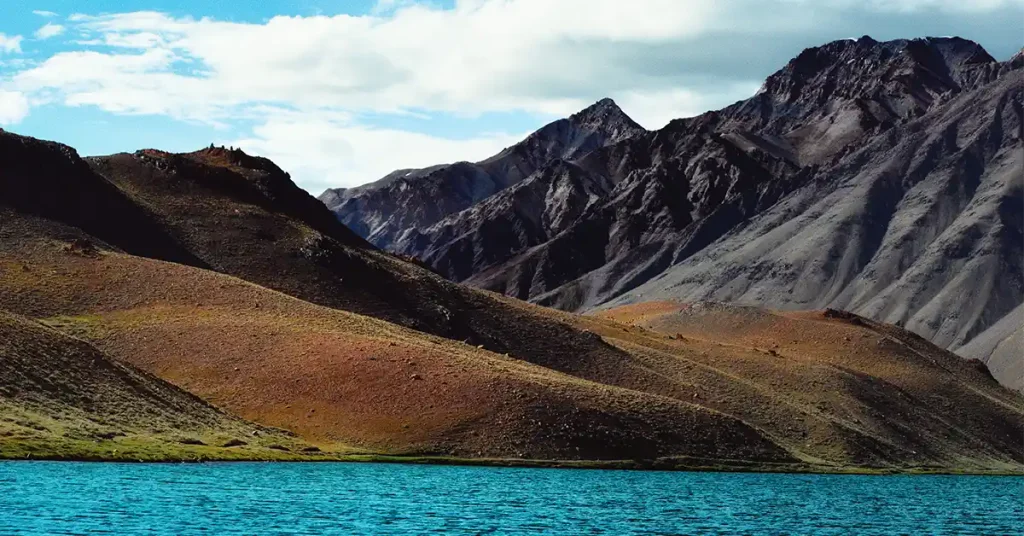
The turnoff to Chandrataal sits roughly 14 km after Kunzum on unpaved track. The parking area is 1 km from the lake. Walk the final kilometer on foot. When the lake appears, it is crescent-shaped, at 4,300 m, and the color shifts between pale turquoise and deep aquamarine depending on the light and angle. Camp here overnight if permits are available. The night sky at Chandrataal, with no artificial light for 30 km in any direction, is a genuinely disorienting experience in the best way.
In June 2026, an estimated 3,500 vehicles arrived at Chandrataal in a single week after the route opened. Book the campsite in advance, and verify current permit requirements before departure.
Overnight: Chandrataal campsite (2 km before the lake) Distance: 60 to 90 km from Kaza Altitude: 4,300 m at the lake
Day 8: Chandrataal to Manali via Batal and Gramphoo (120 km, 5 to 7 hours)
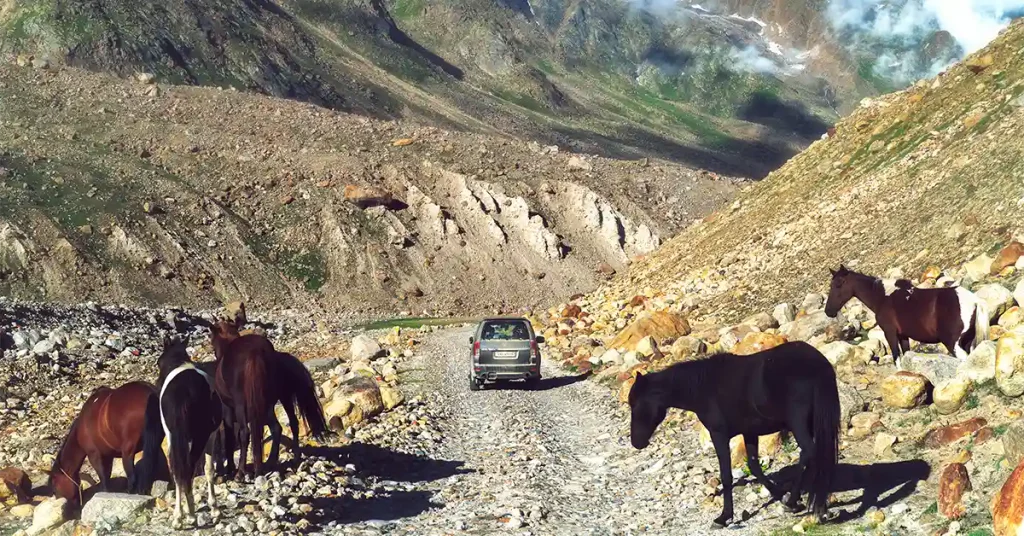
The return to Manali via the Manali-Leh Highway is the most technically demanding driving of the trip. From the Chandrataal turnoff, the road descends through Batal (a small dhaba settlement) and then follows the Chandra River toward Gramphoo Junction. This stretch has multiple water crossings that deepen through the afternoon as snowmelt fills the streams. Drive this section before noon if possible.
For riders who specifically want to cover this Chandrataal to Gramphoo stretch on a motorcycle rather than in a vehicle, The Travel Story’s Spiti Biking Expedition runs the full circuit from the saddle across 6 nights and 7 days, with a backup tempo traveller handling luggage throughout.
After Gramphoo, the road joins the Manali-Leh Highway at Koksar and the quality improves significantly. The Atal Tunnel entrance is 30 km from Gramphoo. The tunnel at 9.02 km bypasses the old Rohtang Pass route and exits into the Kullu Valley just above Manali.
Arrive in Manali in the afternoon. Eat a meal that isn’t tinned food, dal, or omelette. Sleep at a lower altitude for the first time in 5 days.
Overnight: Manali (2,050 m) Distance: 120 km Note: Last fuel on Spiti side was Tandi, 35 km before the Atal Tunnel on the Manali side. Fill up in Manali for the Delhi drive.
Day 9: Manali to Delhi (550 km, 10 to 12 hours)
Leave Manali by 4 AM. The road is clear of traffic at that hour and the Chandigarh to Delhi stretch is manageable by evening. Or take an overnight Volvo from Manali ISBT and arrive in Delhi by morning.
SUMMER ITINERARY AT A GLANCE
| Day | Route | Distance | Overnight | Altitude |
|---|---|---|---|---|
| 1 | Delhi to Shimla | 350 km | Shimla | 2,200 m |
| 2 | Shimla to Reckong Peo | 280 km | Reckong Peo | 2,670 m |
| 3 | Reckong Peo to Nako | 80 km | Nako/Tabo | 3,625 m |
| 4 | Nako to Kaza via Tabo, Dhankar | 150 km | Kaza | 3,800 m |
| 5 | Kaza circuit: Key, Kibber, Chicham, Langza | 70 km local | Kaza | 3,800 m |
| 6 | Kaza circuit: Hikkim, Komic, Pin Valley | 60 km local | Kaza | 3,800 m |
| 7 | Kaza to Chandrataal via Kunzum | 80 km | Chandrataal | 4,300 m |
| 8 | Chandrataal to Manali via Batal, Gramphoo | 120 km | Manali | 2,050 m |
| 9 | Manali to Delhi | 550 km | Delhi | 220 m |
Spiti Valley 7-Day Itinerary: Compact Version from Chandigarh or Delhi
If 9 days is too long, a tighter 7-day Spiti Valley itinerary works — but it requires either starting from Chandigarh (saving one full travel day over Delhi) or accepting that the Sangla-Chitkul detour and a dedicated Pin Valley day are not possible on this schedule.
Starting from Chandigarh saves 3 to 4 hours on both Day 1 and the return day, effectively adding an exploration day without adding a calendar day. Chandigarh is 3 hours from Shimla vs Delhi’s 8 to 9 hours. This is the single most efficient route optimization available to anyone doing a 7-day Spiti Valley itinerary.
| Day | Route | Distance | Overnight |
|---|---|---|---|
| 1 | Chandigarh or Delhi to Narkanda or Rampur | 130-350 km | Narkanda or Rampur |
| 2 | Narkanda to Nako via Reckong Peo | 200 km | Nako |
| 3 | Nako to Kaza via Tabo and Dhankar | 150 km | Kaza |
| 4 | Kaza local: Key, Kibber, Chicham, Langza | 70 km local | Kaza |
| 5 | Kaza: Hikkim, Komic + Chandrataal drive | 80 km | Chandrataal |
| 6 | Chandrataal to Manali | 120 km | Manali |
| 7 | Manali to Delhi or Chandigarh | 550 or 310 km | Home |
What this 7-day Spiti Valley itinerary skips compared to the 9-day version:
- The Sangla Valley and Chitkul detour (adds a full day)
- A dedicated Pin Valley day (needs a third Kaza night)
- A rest day buffer in Kaza (recommended but cut in the 7-day)
What the 10-day Spiti Valley itinerary adds over the 9-day: An extra acclimatization night in Nako, the Sangla-Chitkul detour as a full day rather than a rushed stop, and a separate Pin Valley day from Kaza. Ten days is the most comfortable version of this circuit for families and first-time Himalayan travellers.
The 7-Day Spiti Valley Winter Itinerary: Shimla Route Only
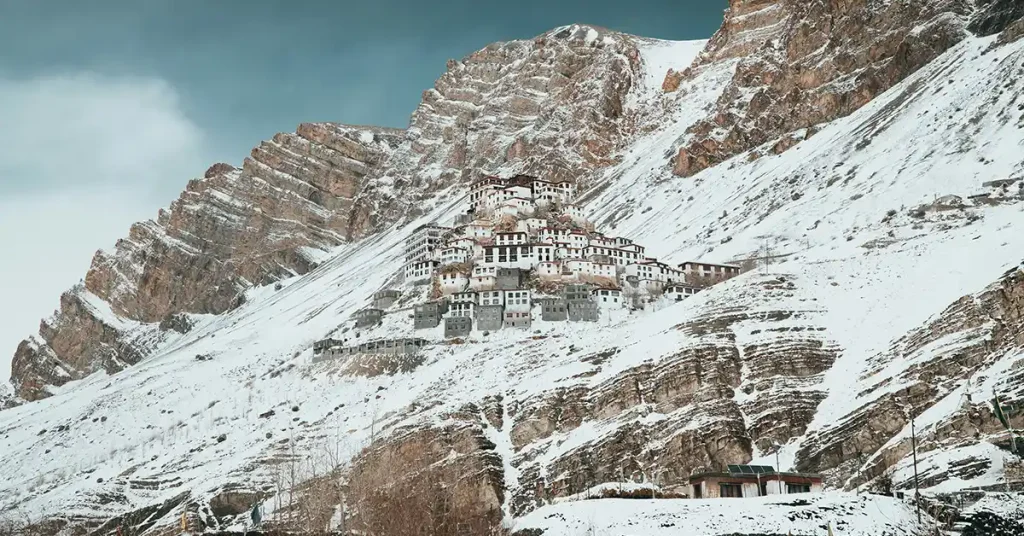
Winter Spiti is not a condensed version of the summer trip. It is a different journey entirely — the same geography under a different set of constraints, with a different reward at the end.
What winter Spiti is: Key Monastery under snow, Kaza market closing before 5 PM, -20°C nights that demand genuine cold-weather preparation, and the possibility of watching a snow leopard move across the rock face above Kibber in early morning light.
What winter Spiti is not: Chandrataal (inaccessible, road buried under snow), the Manali route (Kunzum Pass closed from mid-October), or the casual packing approach that works in September.
The winter route runs Shimla only. No circuit. Enter and exit via the same road. The Travel Story’s Winter Spiti Expedition runs 6N-7D batches through October, November, and December at Rs 17,999, covering Chitkul, Tabo, Kaza, Kibber, Chicham, and Kalpa with the Gue mummy village on the return leg.
Day 1: Delhi to Shimla
The distance is the same as the summer version. The experience of arriving is not.
Winter Shimla is a different city from the one that fills up with families and school trip groups through May and June. The Mall Road in December has actual space on it. The coffee shops around Scandal Point have the heat turned up and room for you to sit without being nudged toward the door. The Christ Church looks better in frost than in sunshine. If you arrive in the morning after an overnight Volvo from Delhi, Shimla gives you a quiet few hours to actually be somewhere before the next day’s driving begins.
What to do in Shimla on arrival:
Shimla sits at 2,220 m. That altitude matters more in winter because the cold hits faster than you expect when you step off the bus. Get a warm breakfast first. The market area near the ISBT has dhaba-style joints that open early and serve everything from parathas to Maggi.
After breakfast, Either you can start your journey towards Spiti Valley riding towards Kinnaur on your first day or if you have extra days you can stay back at Shimla for a leisure day. There you can visit Jakhu Temple which is worth the hour. The ropeway runs year-round and the view from Jakhu Hill at 2,455 m across the snow-dusted ridge line is one of the better free views in Himachal. The Monkey Temple reputation is real though, you should keep bags closed and food out of sight.
The Mall Road in winter has about 20 percent of its summer foot traffic. Walk it without anyone stopping you for photographs. Browse the Himachali shawl shops for anything warm you forgot to pack in Delhi, because nothing practical is available between Reckong Peo and Kaza in winter.
Overnight: Shimla (2,220 m) Distance: 350 km from Delhi Altitude gain: 216 m to 2,220 m
Winter note: Shimla in December-January averages 0 to 5°C during the day. Carry your heaviest warm layer accessible in your daypack, not buried in checked luggage. The bus station area is breezy and the cold announces itself immediately on arrival.
Day 2: Shimla to Reckong Peo (280 km, 9 to 10 hours)
The Kinnaur sections of this road are driveable in winter in a 4WD. The Hindustan-Tibet Highway is maintained, though the section between Powari and Reckong Peo can have ice patches in December and January. Drive this section in the morning when the ice has not yet reformed after the daytime thaw. Keep chains in the vehicle.
From Reckong Peo, the view across to Kinner Kailash range is often clearer in winter than any other season, with no haze and snow on every peak.
Day 3: Reckong Peo to Nako (80 km, 4 to 5 hours)
The Malling Nala section is more stable in winter than monsoon, but ice on the road surface at altitude is the concern. Drive slowly and have chains ready. Nako Lake may be partially or fully frozen. Walk around the lake in the late afternoon — frozen mountain lakes at 3,625 m in winter are a genuinely different visual from the summer version.
Day 4: Nako to Kaza via Tabo (150 km, 5 to 6 hours)
Tabo Monastery in winter has a different atmosphere from summer. The monks are there, the butter lamps are lit, and the prayer sessions are longer. Very few tourists. Stop for as long as the road schedule allows.
From Tabo to Kaza, the road has sections that may require chains in January. Road condition reports from locals in Tabo before departure are more reliable than any app.
Overnight: Kaza
In Kaza during winter: most cafes are closed or open only for a few hours in the late morning. The Sakya Abode restaurant and a couple of dhaba-style kitchens maintain limited service. The market closes by 5 PM. Carry snacks and a thermos.
Day 5: Kaza Sightseeing and Kibber for Snow Leopards
Key Monastery in winter is accessible on a cleared road but conditions should be confirmed locally before departure. The surrounding landscape is completely under snow, and the monastery against the white background is one of the more extraordinary photography opportunities in Spiti.
Kibber and Chicham are where the snow leopard sightings happen. Late December through early January is when the animals move to lower elevations following their prey (bharal, the blue sheep). Early morning drives from Kaza to Kibber (4,270 m), arriving before 7 AM, and stationary watching in the village surrounds is the standard approach. No guarantee — but the chances are meaningfully higher here than anywhere else in the valley, and higher in this window than any other time of year.
Overnight: Kaza

Day 6: Extended Kaza Exploration or Begin Return
Dhankar is accessible from Kaza in winter with a 4WD and confirmed road conditions. Pin Valley road into the national park is generally passable in December and January, and local operators occasionally run winter wildlife watches specifically for snow leopard sightings from within the park.
If returning on Day 6: Kaza to Nako. If extending: one more day in Kaza and return on Day 7.
Day 7: Return via Shimla (reverse route, 2 days to Delhi)
The return follows the same route. Reckong Peo overnight, then directly to Shimla in one long day if conditions allow. Return to Delhi from Shimla the following morning.
WINTER ITINERARY AT A GLANCE
| Day | Route | Distance | Overnight | Key Note |
|---|---|---|---|---|
| 1 | Delhi to Shimla | 350 km | Shimla | Same as summer |
| 2 | Shimla to Reckong Peo | 280 km | Reckong Peo | 4WD essential, ice possible |
| 3 | Reckong Peo to Nako | 80 km | Nako | Check Malling Nala conditions |
| 4 | Nako to Kaza via Tabo | 150 km | Kaza | Tabo in winter is extraordinary |
| 5 | Kaza local: Key, Kibber, Chicham | 60-70 km | Kaza | Early morning for snow leopard window |
| 6 | Extended Kaza / begin return | Variable | Reckong Peo or Kaza | Dhankar accessible if road clear |
| 7 | Return toward Shimla | 150 km | Shimla | Reverse route home |
PLANNING ESSENTIALS FOR BOTH ITINERARIES
Permits: Indian nationals need no special permit for Spiti Valley. Foreign nationals require an Inner Line Permit (ILP), available in Kaza or Reckong Peo. All travellers should carry multiple photocopies of government-issued ID. Checkposts between Shimla and Kaza check documents at multiple points.
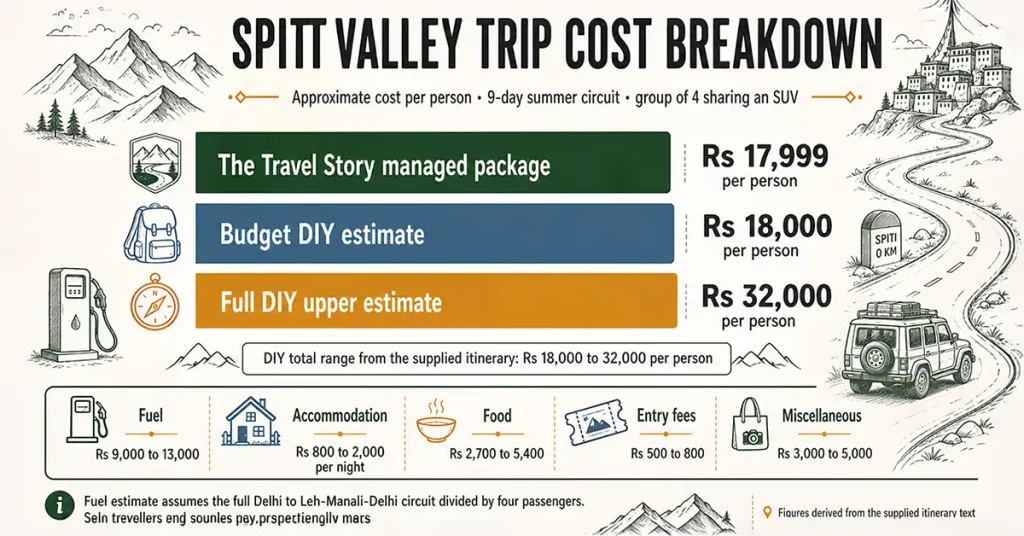
Approximate Cost Per Person (9-Day Summer Circuit, Self-Planned):
| Expense | Budget Range |
|---|---|
| Fuel (SUV, full circuit) | Rs 9,000 to 13,000 |
| Accommodation (per night, mid-range) | Rs 1,000 to 2,000 |
| Food (Rs 300 to 600 per day) | Rs 2,700 to 5,400 |
| Entry fees (monasteries, Chandrataal) | Rs 500 to 800 |
| Miscellaneous (cash buffer, tips) | Rs 3,000 to 5,000 |
| Total per person (group of 4 sharing SUV) | Rs 18,000 to 32,000 |
Fuel costs above are for the full Delhi to Leh-Manali-Delhi circuit divided by four passengers. Solo travellers or couples pay proportionally more because the fuel cost does not divide as efficiently. Group tour packages from The Travel Story cover this at a fixed per-person rate without the DIY cost variability.
Fuel: Fill completely in Reckong Peo on the Shimla route. Only one pump is between Reckong Peo and Kaza which you will find it in Pooh. On the Manali side, Tandi (35 km before the Atal Tunnel) is the last pump before Kaza. Carry a 5-litre jerry can on either route.
Cash: ATMs in Kaza function but run out during peak season. Carry a minimum of Rs 5,000 in cash buffer beyond planned spending. No UPI or card acceptance at homestays, dhabas, or fuel stations beyond Reckong Peo on the Shimla side.
Mobile Network: Jio, BSNL, and Airtel all work in Kaza. Signal drops between major towns and disappears on most passes. Download offline maps before leaving Shimla.
Altitude Management: Two nights minimum before reaching Kaza (Reckong Peo or Nako) is not optional for the Shimla route. On the Manali route, spending one night in Manali before pushing to Kaza is strongly recommended. Carry Diamox (Acetazolamide) prescribed by a doctor before departure, not purchased en route.
For a complete breakdown of how to reach Spiti from Delhi using either route, The Travel Story’s How to Reach Spiti Valley guide covers bus, car, train, and taxi options with current costs.
FAQ: Spiti Valley Itinerary
The best summer itinerary enters via Shimla and Kinnaur (for gradual altitude gain), spends 3 nights in Kaza, and exits via Chandrataal and Manali. Total 9 days covers all major landmarks. A 7-day version is possible but tighter, requiring faster driving days and sacrificing one Kaza exploration day.
The Shimla-Kinnaur route is recommended for first-time visitors because it gains altitude gradually over 3 days, reducing altitude sickness risk. The Manali route via Kunzum Pass is faster but pushes travellers from 2,050 m to 3,800 m in a single day, which is the most common cause of serious AMS on a Spiti trip.
A minimum of 7 days from Delhi for the core Kaza circuit. A 9 to 10 day trip allows for the full Shimla-in-Manali-out circuit including Chandrataal and one rest or buffer day in Kaza. Winter trips require the same 7 to 9 days but without the Chandrataal extension.
Chandrataal is accessible only when Kunzum Pass is open, approximately late May to mid-October. It adds one day to the summer itinerary and is best done as an overnight rather than a day trip from Kaza. Winter itineraries cannot include Chandrataal as the access road is buried under snow.
Not comfortably as a self-planned trip. A 5-day trip from Delhi reaches Kaza in 2 to 3 days and leaves 1 to 2 days for actual sightseeing. The altitude gain from Delhi to Kaza without adequate acclimatization stops over 5 days is aggressive and increases AMS risk significantly. Seven days is the realistic minimum for a DIY trip. For travellers with exactly 5 days and budget constraints, The Travel Story’s Spiti Half Circuit Expedition runs a 4N-5D Manali-based loop at Rs 12,999 that covers Kaza, Key Monastery, Hikkim, Langza, Komic, and Chandrataal with logistics fully managed so the altitude and schedule are handled without improvisation.
The winter Spiti itinerary follows the Shimla-Kinnaur route only (Manali side and Kunzum Pass are closed). It covers Reckong Peo, Nako, Tabo, and Kaza over 4 days, spends 1 to 2 nights in Kaza for Key Monastery and Kibber snow leopard sightings, and returns the same way. Total 7 to 9 days from Delhi.
Kunzum Pass (4,551 m) typically opens in late May to early June, depending on BRO snow clearance. The pass closes with the first significant snowfall after mid-October, sometimes as early as late September in heavy snow years. Always verify BRO road status before planning a Chandrataal extension to the itinerary.
Yes, via the Shimla-Kinnaur route, with older children (above 8 to 10 years). The gradual altitude gain reduces AMS risk. Daily driving distances should be kept under 6 hours. Children under 5 are not recommended given combined altitude and limited medical facilities. Keep at least 2 nights in Kaza before driving to higher points like Komic (4,587 m).
Two nights is the minimum to cover Key Monastery, Kibber, Chicham, and Langza. Three nights allows for the upper village loop (Hikkim, Komic), a Pin Valley day trip, and a genuine rest day. Three nights in Kaza is the sweet spot for most travellers.
On the Shimla route, the last petrol pump before Kaza is in Reckong Peo. On the Manali route, the last pump before the high-altitude section is Tandi (35 km before the Atal Tunnel on the Manali side). Carry a 5-litre jerry can. No fuel is available at Losar, Batal, Gramphoo, or between Nako and Kaza.
Conclusion
A Spiti Valley itinerary is not complicated. It is demanding. The two are different problems, and most planning mistakes happen from treating them as the same thing.
The summer circuit (Shimla in, Manali out, Chandrataal on the way) is one of the most complete road trips possible in India within a 9-day window. Everything changes gradually: the landscape, the altitude, the culture, and the internal state you’re in by the time you reach Chandrataal and understand why someone named a lake after the moon.
The winter itinerary strips that down to the essential bones of the valley: Tabo’s thousand-year-old murals, Kaza’s empty market streets, Key Monastery against a white landscape, and the specific cold-morning patience of waiting near Kibber to see if a snow leopard decides to move.
Both are worth doing. The summer version gives you more. The winter version gives you the place more completely.
For travellers who want the circuit managed by people who have done it across every season, The Travel Story’s Spiti with Chandrataal package covers the full summer circuit with trip captain, backup vehicle, and itinerary planning built around the actual road conditions rather than a generic template.

Salman Hashmi is a travel industry expert, group travel leader, and destination specialist with over 3 years of hands-on experience in travel operations, trip management, and destination planning across India now working as a Marketing Executive. His expertise extends beyond leading trips on the ground to managing the critical backend logistics that ensure seamless travel experiences, including itinerary planning, vendor coordination, traveler support, and operational execution.
Over the years, Salman has successfully organized and led group tours to destinations such as Spiti, Kashmir, Tirthan-Jibhi, Jaisalmer, Shangarh, Chopta-Tungnath, Auli, Chakrata, Badrinath, Valley of Flowers, Udaipur, Harsil Valley, and many more. His extensive field experience provides deep insights into local cultures, regional traditions, historical landmarks, and destination-specific travel experiences. Through continuous exploration and interaction with local communities, he has developed a strong understanding of India’s diverse history, heritage, and cultural landscapes.
In the past, Salman has collaborated with and hosted well-known content creators including Richi Shah, TheMaahie, and Trahuller, while managing travel experiences for more than 700 travellers. His combination of on-ground leadership, operational expertise, destination knowledge, and understanding of local history and culture enables him to create trustworthy, experience-driven travel content that helps readers make informed travel decisions with confidence.