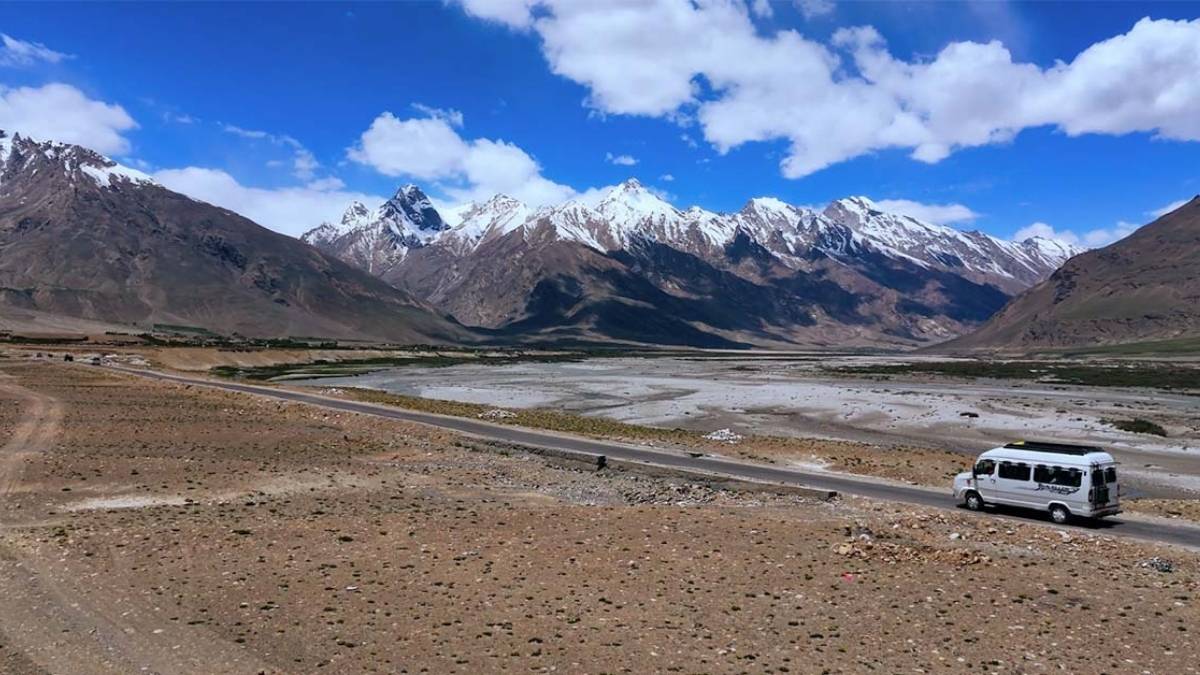
Most Himalayan valleys ease you in. The road gets rougher a little at a time, the signal fades slowly, and there is usually another way out. Zanskar does not work like that. Zanskar Valley is a high cold desert in Ladakh, and most travellers reach its main town, Padum (3,657 m), by one of two seasonal roads: over Shinkula Pass from Manali, or over Pensi La from Kargil. Both roads close under snow in winter.
Zanskar also became its own district on 27 April 2026, with Padum as the headquarters. Before that it sat inside Kargil district, so older guides and some maps still say Kargil.
This guide covers both routes with real distances, the places worth your time, when the roads are open, and the small practical things (cash, SIM cards, altitude) that catch first timers out. Facts were checked in October 2026. Roads and weather change fast in Zanskar, so use this as a plan and confirm on the day you travel.
The Travel Story's Zanskar Valley Expedition is a fixed departure road trip that runs from Manali over Shinkula Pass and covers Gonbo Rangjon, Phugtal Monastery, Karsha and Padum. Batches have 12 to 16 travellers, a trip captain stays with the group, and departures run from June to September. See the day by day plan and open dates on the trip page.

Zanskar Valley at a Glance
The table below puts the main Zanskar Valley facts in one place. Where sources disagree, a range is shown.
| Detail | Data |
|---|---|
| Region | Zanskar district, Ladakh, India (a separate district since 27 April 2026, earlier part of Kargil district) |
| Main town | Padum, about 3,657 m |
| Terrain | Cold desert behind the Great Himalaya. Valley floor near 3,500 m, with peaks above 6,000 m |
| Best time to visit | June to September |
| Winter | Roads shut. The Chadar Trek runs on the frozen Zanskar River in January and February when the ice is safe |
| Shinkula Pass (Manali side) | About 5,050 to 5,090 m (16,580 to 16,703 ft, depending on the source) |
| Pensi La (Kargil side) | 4,401 m (14,436 ft) |
| Road distance to Padum | About 210 to 230 km from Manali. About 230 to 240 km from Kargil |
| River | Zanskar River. It forms near Padum where the Stod (Doda) and Tsarap rivers meet, and it joins the Indus near Nimmu |
| Main landmarks | Phugtal Monastery, Karsha Monastery, Stongdey Monastery, Zangla Palace, Gonbo Rangjon, Drang Drung Glacier, Sani |
| Airport | None in the valley. Nearest are Leh and Srinagar |
| Mobile network | Patchy. Postpaid SIMs work best, and long road stretches have no signal |
What Makes Zanskar Valley Different
Zanskar has no gentle approach. In most Himalayan regions you climb in steps, with towns and fuel pumps along the way. Here, every road in crosses a high pass, and those same passes cut the valley off once the snow arrives.
That shapes the whole trip. The monasteries are working institutions where monks study and pray every day, not museums kept open for visitors. The villages grow barley and peas in a short summer and go quiet in winter. The mountains are bare and brown, and next to them a glacier-fed river runs a bright turquoise. At night the sky is dark enough to see the Milky Way clearly.
One honest warning. Zanskar punishes tight schedules. A bridge failure, a landslide or fresh snow can change the plan for a day, so good itineraries keep one spare day. If your leave is fixed to the exact day, pick a shorter trip.
How to Reach Zanskar Valley
Zanskar Valley can only be reached by road, because the valley has no airport. The nearest airports are Leh (Kushok Bakula Rimpochee) and Srinagar. From Delhi, most travellers take an overnight bus to Manali (the nearest airport is Bhuntar near Kullu) and drive on from there, or fly to Srinagar or Leh and drive via Kargil.
The table compares the two routes most travellers use.
| Detail | Manali route (Shinkula Pass) | Kargil route (Pensi La) |
|---|---|---|
| Starts from | Manali, Himachal Pradesh | Srinagar or Leh, via Kargil |
| Distance to Padum | About 210 to 230 km from Manali crossing Shinkula Pass and Purne | About 230 to 240 km from Kargil |
| Driving time | 2 days, with a night at Jispa or Darcha | 1 long day of about 8 to 10 hours. A night at Rangdum splits it |
| Highest point | Shinkula Pass, about 5,050 to 5,090 m | Pensi La, 4,401 m |
| Road | Tarmac to Darcha, then a mix of tarmac and rough stretches as road work continues | Tarmac and gravel, with the section after Pensi La unpaved |
| Usually open | Late May or June to September or early October, depending on snow | May or June to October |
| On the way | Jispa, Shinkula, Gonbo Rangjon, Kargyak, Purne, Phugtal | Suru Valley, Rangdum Monastery, Pensi La, Drang Drung Glacier |
| Best for | Travellers coming from Delhi and Manali, and anyone who wants Phugtal | Travellers arriving by air into Srinagar or Leh |
Route 1: Manali to Padum over Shinkula Pass
The Manali route reaches Padum in two days, climbing through Lahaul and crossing Shinkula Pass. The stops in order are Manali, Keylong, Jispa, Darcha, Shinkula Pass, Lakhang, Gonbo Rangjon, Kargyak, Purne and Padum. Shinkula typically opens in late May or June and closes by late October but dates move every year with the snow. The distance from Manalai to Padum is around 210-230 km
Just after the pass, on the Zanskar side, the road reaches the base of Gonbo Rangjon. Kargyak is the first village of Zanskar. Past Purne, the road runs by Mune and Bardan monasteries before it reaches Padum.

Route 2: Kargil to Padum over Pensi La
The Kargil route is usually done in one long day. From Srinagar the road goes through Sonamarg, Zoji La, Drass and Kargil. After Kargil it follows the Suru Valley, where green lower slopes slowly turn into cold desert on the climb to Rangdum. Rangdum sits in Suru Valley but is Zanskari in culture, and its monastery makes a good stop. From Leh, Kargil is about 220 km, so Leh to Padum via Kargil is about 450 km over two days.
Pensi La is a watershed. Water on the Kargil side drains towards the Suru River, and water on the Padum side feeds the Stod (Doda) River. Just after the pass, the Drang Drung Glacier comes into view beside the road.
A third road also exists. The Nimmu Padum Darcha road links Padum with Leh through Chilling and Nimmu. Traveller reports on that stretch were mixed in 2026, so ask a local operator before you plan around it.
What the Nimmu Padum Darcha road changed
The Nimmu Padum Darcha (NPD) road, about 298 km long, was connected by the Border Roads Organisation in March 2024. Blacktopping and widening work was still going on through 2026, so the road is open for the season but not yet a finished all weather highway. The biggest change for visitors is Phugtal. The road now reaches Purne, so the monastery is a half day hike instead of a multi day trek.

Check the road on the morning you travel
The Zanskar branch near Darcha and Shinkula is reported separately from the main Manali Leh highway. The highway being open does not mean the Zanskar road is open. Recent examples show why. Flash floods blocked the Shinkula road on 2 September 2025. A bridge failure near the pass disrupted traffic on 1 May 2026, and the road reopened to all vehicles around 10 May 2026 after snow clearance. Ask your driver or guesthouse about the exact road status each morning, and keep one buffer day.
Landmarks and Places to Visit in Zanskar Valley
Phugtal Monastery, Lungnak Valley
Phugtal Monastery is built around a natural cave on a cliff face in the Lungnak Valley. The name comes from "phug" (cave) and "tal" (liberation). The cave has been used for about 2,500 years, and the monastery was founded in the early 15th century. The buildings climb the rock in tiers, and many visitors compare them to a honeycomb pressed into the cliff.
From Purne, the walk to the monastery is about 6 km and takes 2 to 3 hours each way, beside the turquoise Tsarap River. The drive from Padum to Purne takes about 2 to 2.5 hours. Phugtal is an active centre of Tibetan Buddhist study. Remove your shoes at the entrance, keep quiet in the prayer halls, and ask before photographing monks or ceremonies.
Gonbo Rangjon, the standalone sacred peak
Gonbo Rangjon is a pyramid of rock that stands alone on the valley floor, with no neighbouring ridges. It sits a little way past Shinkula on the Manali route, so you cannot miss it. Locals treat it as a protector mountain, and many believe the cliff face carries the image of the Buddha. A 30 minute stop at its base is worth it even on a tight day.

Karsha Monastery, above the plain near Padum
Karsha is the largest monastery in Zanskar and dates back to at least the 10th century. Whitewashed buildings climb a steep red cliff above the plain, about 10 to 14 km from Padum depending on the route. The Karsha Gustor festival, with masked cham dances, is usually held in July. Festival dates follow the Tibetan lunar calendar, so they shift each year. Confirm them locally before you plan around them.

Stongdey Monastery
Stongdey is the second largest monastery in Zanskar, about 18 km north east of Padum on the road to Zangla. It stands on a rocky rise above the village, and its founding is traditionally dated to 1052. You reach it by road, and the climb to the entrance is short but steep. The view over the Zanskar plain from the rear of the monastery is one of the better panoramas you can get without a full trekking day.
Zangla Palace
Zangla Palace is the former seat of the Zanskar royal family, on a hill above Zangla village, roughly 30 to 40 km north of Padum. Zangla is also an old capital of Zanskar. A small monastery in the village is linked to the palace's history.

Drang Drung Glacier, near Pensi La
Drang Drung Glacier is about 23 km long and is one of the largest glaciers in Ladakh outside the Karakoram. It is the source of the Stod (Doda) River. You see it from the road just after you cross Pensi La towards Padum, and a short walk gets you closer. Photos rarely show the true size.

Padum as a base: distances and time needed
Padum is the easiest base for day trips. The distances below are approximate, because sources differ by a few kilometres.
| Place | Approx. distance from Padum | What to expect |
|---|---|---|
| Sani Monastery and Sani Lake | About 6 km | A short half day stop |
| Karsha Monastery | About 10 to 14 km | Largest monastery in Zanskar. Allow 2 to 3 hours |
| Stongdey Monastery | About 18 km north east | Second largest monastery. Short road, steep final climb |
| Zangla Palace | About 30 to 40 km north | Old royal seat. Combine with Stongdey in one day |
| Phugtal Monastery | 2 to 2.5 hours by road to Purne, then 2 to 3 hours on foot each way | A full day, or a night at Purne |
Adventures in Zanskar Valley
The Chadar Trek, January to mid February
The Chadar Trek is a winter walk on the frozen Zanskar River, usually from Chilling to Nerak, when the ice is thick enough to hold people. Temperatures can fall to minus 30°C or lower, and the ice changes daily.
Treat it as weather dependent, never guaranteed. Reports from January 2026 say the trek was suspended because stable ice did not form. Local operators linked this to warmer winters and to debris from road work falling into the river. Road construction has also shortened the classic route in recent years. Book only with an operator who explains clearly what happens if the ice fails.
Lamayuru to Padum trek
This is a 7 to 10 day crossing from Lamayuru Monastery in Ladakh to Padum, over high passes such as Singe La. It passes remote villages that see very few outside visitors. It needs camping gear, a guide and good fitness. It is not a trip to attempt without an experienced operator.
Zanskar River rafting
Operators run multi day rafting expeditions on the Zanskar River, with rapids through deep canyon walls that no road reaches. Routes and grades differ between operators, so ask for the exact stretch, the rapid grade and the safety kit before you book.

Best Time to Visit Zanskar Valley
The best time to visit Zanskar Valley is June to September, when the roads on both routes are usually open. Zanskar itself is a dry cold desert, because the Himalaya blocks the monsoon. The roads leading to it are another matter. Cloudbursts, flash floods and landslides have closed them in the rainy months.
| Month | Roads | Weather and notes |
|---|---|---|
| May | Pensi La road usually opens. Shinkula reopened around 10 May in 2026 after snow clearance, but only 4x4 vehicles passed in late April | Cold, with snow on the passes. Road status changes day to day. Only for flexible travellers |
| June | Both roads normally open | Cool days, cold nights, snow patches on higher ground. A quieter start to the season |
| July | Open | The most stable weather and the longest days. Karsha Gustor is usually held this month |
| August | Open, with delays possible from rain on approach roads | Stable in the valley itself. Keep a buffer day |
| September | Open | Clear skies and good light for photos. Nights get colder. A flash flood closed the Shinkula road on 2 September 2025, so keep a buffer day |
| October | Open until the first heavy snow | Weather turns unpredictable and the passes can shut at short notice |
| November to April | Shinkula Pass and Pensi La normally closed | Temperatures of minus 30°C or lower. The Chadar Trek runs in January and February if the ice allows |
Daytime temperatures in summer are around 10 to 15°C, and nights often fall below 5°C. The right month depends on what you want:
- First visit, safest odds: July or August, with one buffer day.
- Clear skies and fewer vehicles: September.
- A monastery festival: July for Karsha Gustor. Stongdey Gustor falls in the Tibetan 11th month, which is a winter festival.
- A winter adventure: January to mid February, for the Chadar Trek, if the ice forms.

Practical Travel Tips for Zanskar Valley
Cash and fuel
- Fill the tank at Tandi on the Manali side or in Kargil. Padum has a couple of pumps, but supply can run short.
- Do not plan around an ATM or UPI in Zanskar. Withdraw cash in Manali or Kargil first.
- Carry about Rs 3,000 to 5,000 per person in cash for a 4 to 5 day stay in the valley.
Mobile network and SIM cards
- Carry a postpaid SIM. Prepaid SIMs from other states generally do not work in Ladakh and Kargil.
- BSNL has the widest reach. Jio has had 4G in Padum since 2020 and Airtel since 2023, but the signal drops over long stretches, including near Shinkula Pass and Purne.
- Download offline maps before you leave Manali or Kargil. Plan to be offline for long parts of the drive and outside Padum. Tell family your route and rough timings in advance.
Altitude
- Padum sits at about 3,657 m, and the passes go above 5,000 m. Where you sleep matters more than how high the pass is.
- Talk to a doctor before the trip about altitude medicine such as Diamox (acetazolamide). Do not start it for the first time from a pharmacy on the road.
- Build in a rest day before long high pass days. If you fly into Leh first, plan at least two nights there to adjust.
Gear
- A windproof and waterproof outer layer, even in summer.
- Thermal base layers, because nights are cold.
- Trekking shoes with ankle support for the monastery hikes.
- SPF 50 or higher sunscreen, UV sunglasses and lip balm.
- A water bottle with a filter, a power bank and printed copies of your ID and bookings.
Medical help
- Padum has a basic district hospital, best treated as emergency care only.
- The nearest larger hospital is in Kargil, about 230 to 240 km away.
- Choose travel insurance that covers altitude up to 5,000 m and emergency evacuation.
Permits, ID and where to stay
Indian citizens do not need a special permit for Zanskar as of 2026, but you should carry your government ID and photocopies, because checkposts on the routes ask for them. Foreign nationals should confirm current permit rules with a registered operator in Leh or Kargil before travel. Padum has guesthouses, small hotels and homestays. Purne, Karsha, Rangdum and other villages on the main routes offer basic homestays. There is no luxury or resort stay anywhere in the valley.
Want the stress of logistics handled? Our Zanskar Valley Expedition keeps the group together with a trip captain, so road checks, stays and timings are not on you.

Local Culture and Etiquette in Zanskar Valley
Zanskar is Tibetan Buddhist in language, architecture, daily routine and festival calendar. The valley opened to general tourism only in the mid 1990s, and its culture is among the most intact in the Indian Himalaya.
- Remove your shoes before entering any monastery or home.
- Ask permission before photographing monks, elderly residents or ceremonies.
- Walk clockwise around stupas and mani walls (long walls of carved prayer stones), with the wall on your right.
- Buy from village shops and eat at local guesthouses. The valley economy runs on a very short season.
- Slow down. Visitors who match the local pace tend to get more from conversations.
- Festivals such as Karsha Gustor, Stongdey Gustor and Phugtal Gustor bring whole communities together. Dates follow the Tibetan lunar calendar and change each year.

Common Zanskar Planning Mistakes
- Assuming the road is open because the Manali Leh highway is open. The Zanskar branch at Darcha has its own status. Check it each morning.
- Thinking the NPD road makes Zanskar easy. The road is connected, but work was still on in 2026, and sections are rough or washed out after rain.
- Expecting the Chadar Trek every winter. It depends on safe ice, and 2026 showed it can be suspended.
- Bringing a prepaid SIM. Carry a postpaid one, and expect long offline stretches anyway.
- Counting on cash machines. Take cash from Manali or Kargil.
- Booking a tight schedule. One buffer day saves many trips.
Is Zanskar Right for Your Next Trip?
Choose Zanskar if you want remote landscapes, working monasteries and few other visitors, and you are fine with long drives, basic stays and patchy network. If that sounds like too much, other high altitude trips are easier to start with:
- For a first Himalayan road trip with more stays and a well worn circuit, see Spiti Valley trips.
- For big passes like Khardung La and lakes like Pangong, see Leh to Leh with Khardung La or the wider Ladakh travel guide.
- For the full Zanskar picture with all trips and guides in one place, start at the Zanskar travel page and the Zanskar Valley itinerary.
Final Thoughts on Visiting Zanskar Valley
Zanskar does not compete for visitors. The short season, the high passes and the lack of facilities act as a natural filter. People who reach Padum are usually the ones who prepared well. The reward is real remoteness: Phugtal built into its cliff, Gonbo Rangjon standing alone on the valley floor, the Drang Drung Glacier beside the road, and a turquoise river in a gorge no road enters.
These things are not staged for visitors. They ask you to arrive informed, with the right gear, and with enough time. If you would rather have the route, stays and road calls handled by a team that runs it every season, check the dates for the Zanskar Valley Expedition. Batches run from June to September.
Last checked: October 2026. Road status, pass opening dates, network coverage and festival dates change often. Confirm them locally before you travel.