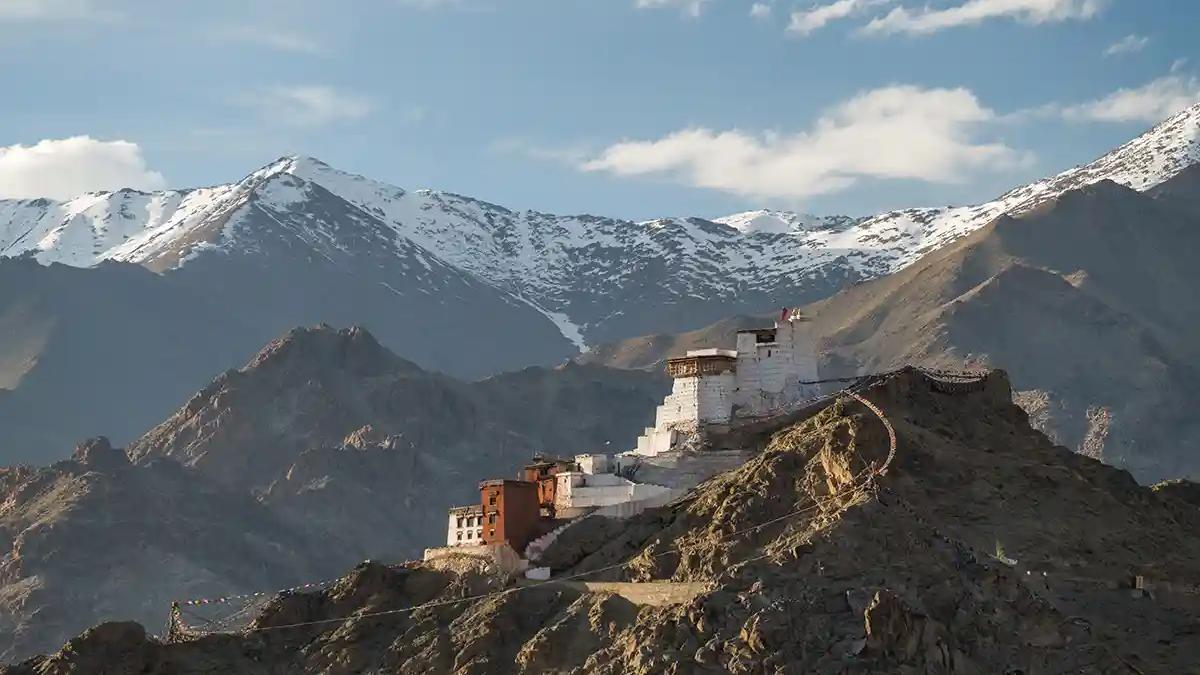
Ladakh sits at the northern edge of India, separated from the rest of the country by some of the highest mountain passes in the world. Getting there from Delhi is not a single decision. It is a series of decisions: how much time you have, whether the journey itself is part of the experience you are looking for, what budget you are working with, and which season you are traveling in. The answer is different for every traveler.
This guide covers all five realistic ways to reach Ladakh from Delhi. Each one is explained with the actual distances, costs, and conditions that matter in 2026. Two of them involve flying. Three involve roads. All of them have trade-offs that are worth understanding before you book anything. Once you have settled on a route, the Ladakh destination guide covers what the region holds once you are there — the lakes, the passes, the circuits, and what each part of Ladakh is actually like.
For travelers who want the Ladakh experience fully planned, including transfers and accommodation across the circuit, The Travel Story's Leh Ladakh Full Circuit handles the logistics from Delhi to Leh and back with group departures through the season.

The Quick Comparison: All Five Routes at a Glance
| Mode | Distance | Time | Approx Fuel Cost (One Way) | Season |
|---|---|---|---|---|
| Flight (Delhi to Leh direct) | ~620 km air | 1.5 hours | Rs 8,000 to 15,000 per ticket | Year round |
| Road via Manali | ~1,060 km | 2 days | Rs 11,500 to 14,500 fuel (SUV, 10 kmpl) | Late May to mid-October |
| Road via Srinagar | ~1,320 km | 2 days | Rs 14,500 to 18,000 fuel (SUV, 10 kmpl) | May to November |
| Train + Road | 580 km train + 700 km road | 2.5 to 3 days | Rs 1,200 to 1,800 train + road costs | Year round (train); season-dependent (road) |
| HRTC Bus Delhi to Leh | ~1,026 km | 30 to 33 hours | Rs 2,500 to 3,500 per person | June to September |

Route 1: By Flight from Delhi to Leh
Time: 1.5 hours Cost: Rs 8,000 to 15,000 one way in regular season; Rs 15,000 to 25,000 in peak June to August Airport: Kushok Bakula Rimpochee Airport, located 9 km from Leh city centre
Flying is the fastest way to reach Leh and the only option that works in winter when road routes are closed. IndiGo, Air India, SpiceJet, and GoFirst all operate the Delhi to Leh route, with multiple daily departures in season. The airport is a joint civil-military terminal and security is thorough; carry a printed copy of your ticket and ID.
The one critical consideration for people flying into Leh is altitude. Leh sits at 3,500 metres above sea level. Arriving by flight means your body goes from sea level to high altitude in 90 minutes with no gradual adjustment. Spend the first day in Leh doing nothing strenuous. Eat light, drink water, avoid alcohol, and resist the urge to immediately head to Pangong or Nubra. Altitude sickness after flying in is common and manageable, but only if you treat the first day as a rest day.
Who should fly: Travelers with 7 days or fewer. First-time Ladakh visitors who want to maximize time in the region rather than spending 4 days on the road. Anyone traveling outside the May to October road season.
Route 2: Delhi to Leh via Manali (The Manali-Leh Highway)
Total distance from Delhi: Approximately 1,026 km Manali to Leh segment: 427 km via the Atal Tunnel Recommended time: 2 days with an overnight stop at Jispa or Keylong Season: Late May to mid-October (governed by Baralacha La snow clearance)
This is the route that most road-trip travelers take and the one that most defines the overland Ladakh experience. The journey breaks down into two distinct days.
Day 1: Delhi to Jispa or Keylong (530 to 560 km) Leave Delhi by 5 AM to clear city traffic before 7 AM. The road runs via Chandigarh and then climbs through Kullu and Manali before the Atal Tunnel takes over from the old Rohtang Pass route. The Atal Tunnel, opened in 2020, is 9.02 km long at 3,060 metres and bypasses the traffic and weather delays that once defined the Rohtang crossing. It saves 46 km of distance and 2 to 3 hours of time. After the tunnel, the road enters the Lahaul Valley and follows the Chandra River through Sissu and Tandi before reaching Keylong (the headquarters of Lahaul and Spiti district) and then Jispa, a small village that functions as the standard overnight stop.

Note the fuel situation here: the last reliable fuel stop before Leh is Tandi, near Keylong. Fill up completely before leaving Tandi regardless of how much is in the tank.
Day 2: Jispa to Leh (approximately 370 km) This is the day that justifies the entire road trip. The route crosses four high mountain passes in sequence. Baralacha La at 16,047 feet is the first major test, usually reached by mid-morning. Near the summit, Suraj Tal sits at 16,500 feet, one of the highest lakes in India and worth a 15-minute stop. The road then descends to Sarchu, a camp settlement at 14,000 feet that functions as a rest stop rather than an overnight destination for most travelers.
After Sarchu, the Gata Loops begin: 21 hairpin bends climbing from the valley to the Nakee La and Lachulung La passes. The road surface here has some rough patches and the altitude gain is rapid. The More Plains beyond Lachulung La are where Tibetan wild asses (kiangs) are regularly spotted walking alongside or across the road.

The final pass before Leh is Tanglang La at 17,582 feet, the third highest motorable pass in the world. From the summit, the road drops continuously toward Upshi and then follows the Indus River into Leh. The city appears below you after the descent with the Stok Kangri range visible behind it.

Stops worth making on the Manali route:
- Sissu Waterfall (15 minutes, just after the Atal Tunnel exit)
- Deepak Tal (a small blue lake before Jispa)
- Suraj Tal near Baralacha La
- More Plains for kiangs
- Tanglang La summit
Honest notes:
- Locals sometimes drive Manali to Leh in one day. Do not do this. The altitude gain from Manali to Leh in 14 hours is too rapid for most travelers and the risk of altitude sickness on arrival in Leh is significantly higher.
- The Manali-Leh Highway typically opens late May to early June. The exact date is determined by Baralacha La snow clearance by BRO. Check BRO's official road status updates before planning around any specific date in May.
- Mobile network is essentially absent between Jispa and Upshi. Download offline maps for the Manali-Leh Highway before leaving Manali.

Route 3: Delhi to Leh via Srinagar (The Srinagar-Leh Highway)
Total distance from Delhi: Approximately 1,050 km Srinagar to Leh segment: 430 km via Zoji La and Kargil Recommended time: 2 days with overnight at Kargil Season: May to November (slightly longer window than the Manali route)
The Srinagar route is the better choice for first-time visitors to Ladakh because it gains altitude more gradually. The road climbs through the Kashmir Valley from Srinagar at 1,600 metres, passes Sonamarg at 2,800 metres, crosses Zoji La at 3,528 metres, reaches Drass (3,230 metres), and arrives at Kargil (2,676 metres) for the overnight stop. By the time a traveler reaches Leh the following day, the body has had nearly 48 hours to adjust to increasing altitude in manageable steps.

Day 1: Delhi to Srinagar (890 km by road) or fly Delhi to Srinagar then continue Most travelers on the Srinagar route either fly to Srinagar or drive Delhi to Jammu on day one and cover Jammu to Kargil on day two. Driving from Delhi all the way to Srinagar in one day is a 14-plus hour push that leaves little for the actual Ladakh portion. A more practical split is:
Day 0: Delhi to Jammu by road or train (580 km by road, 9 hours by Rajdhani Express) Day 1: Jammu to Kargil via Srinagar (500 km, full day) Day 2: Kargil to Leh (230 km, 5 to 6 hours)
The landscape on this route is entirely different from the Manali approach. Srinagar's Dal Lake and the Kashmir Valley give way to the brown terrain of Zoji La and then the extraordinary moonscape of Lamayuru, which the road passes on the way to Leh.

The 2026 update worth knowing: Improved drainage systems along sections of the Srinagar-Leh Highway have reduced some landslide risk on the Zoji La approach compared to previous years. Zoji La remains weather-sensitive and can close for 24 to 48 hours after heavy snowfall even in season. Check AccuWeather for the Zoji La section specifically before driving.
Who should take the Srinagar route:
- First-time Ladakh travelers (gradual altitude gain)
- Travelers who also want to visit Kashmir as part of the trip
- Anyone driving in June when Manali-Leh Highway conditions are still rough from the recently-cleared snow
The circuit approach, entering via Srinagar and exiting via Manali or vice versa, gives you two completely different landscapes across a single trip. For a 12 to 14 day journey, this is the recommended structure.
Route 4: By Train to Jammu + Road to Leh
Total journey: Delhi to Jammu Tawi by train (580 km, 9 hours) then Jammu to Leh by road (700 km, 2 days) Best train options from Delhi: Jammu Rajdhani Express (12445), Swaraj Express (12471), Sarvodaya Express (12473) from Hazrat Nizamuddin or New Delhi stations Train cost: Rs 500 to 1,800 depending on class Banihal railway station is now the closest station at 510 km from Leh, reachable from Delhi via the Udhampur-Srinagar-Baramulla Rail Link
There is no direct train to Leh. The Jammu Tawi station is 663 km from Leh city. People regularly search "Delhi to Leh train" expecting a direct connection, and the answer is the same as it has been for years: it does not exist. Railway projects in the region are ongoing but no completion date has been confirmed for tracks reaching Leh.
The train-plus-road combination makes sense for budget travelers who are not driving their own vehicle. Take the overnight Rajdhani from Delhi, arrive in Jammu early morning, and pick up a shared taxi or private cab to Srinagar or Manali as the next leg of the journey. This avoids the expensive Delhi-to-Manali or Delhi-to-Srinagar road leg while keeping the budget manageable.
Route 5: HRTC Bus from Delhi to Leh
Journey time: 30 to 33 hours Departure point: Delhi ISBT Kashmiri Gate Fare: Rs 2,500 to 3,500 per person Season: June to September (not operational when roads close) Route: Delhi to Keylong to Leh via the Manali-Leh Highway
The HRTC (Himachal Road Transport Corporation) runs the only direct bus service connecting Delhi to Leh. It crosses four high-altitude passes: Baralacha La, Nakee La, Lachulung La, and Tanglang La. The maximum altitude on the route is 17,582 feet at Tanglang La.
This is the cheapest way to reach Ladakh from Delhi and one of the more physically demanding. Passengers sit in the bus for 30-plus hours with brief halts at Mandi, Kullu, Manali, and Keylong. The seats are standard bus seats. The road beyond Keylong is not designed for comfort.
The bus makes sense for solo budget travelers who want to reach Leh without a vehicle and without flying. Book tickets at the Delhi ISBT booking counter well in advance for July and August departures, when demand is highest.

Which Route Should You Take?
| Traveler Profile | Best Route | Why |
|---|---|---|
| Short trip (7 days or fewer) | Flight | Maximize time in Ladakh rather than on the road |
| First-time Ladakh visitor | Srinagar route in, Manali route out | Gradual altitude gain, two different landscapes |
| Biker or road-trip enthusiast | Manali route | Four passes, Gata Loops, More Plains, full high-altitude experience |
| Budget backpacker | HRTC Bus or Train to Jammu then road | Cheapest way in; physically tough but financially light |
| Traveler combining Kashmir and Ladakh | Srinagar route | One continuous road journey through both destinations |
| Winter traveler (November to April) | Flight only | All road routes close or become unreliable in winter |
Practical Tips Before You Leave Delhi
Fuel: Last reliable fuel before Leh on the Manali route is at Tandi, near Keylong. Fill completely. Carry a 5-litre jerry can as backup for the high-altitude section. For budgeting purposes: a one-way Delhi to Leh drive via Manali covers approximately 1,060 km. At 10 kmpl and Rs 110 per litre, that works out to roughly Rs 11,500 to 12,000 in fuel one way. The full return circuit (Delhi to Leh via Manali, return via Srinagar, or the same route back) adds up to 2,200 to 2,600 km total depending on stops, bringing the full round-trip fuel estimate to Rs 24,000 to 29,000 for an SUV. Mountain terrain and low gear driving on high passes will reduce actual mileage below the flat-road figure, so budget toward the higher end.
ATM: The last functioning ATM before Leh on the Manali route is at Keylong. Carry enough cash for the full journey plus a buffer for Leh, where ATMs work but queues can be long in peak season.
Mobile network: Jio, BSNL, and Airtel all work in Leh city. Between Jispa and Upshi on the Manali route, expect effectively no signal for 6 to 8 hours. Download offline maps (Maps.me or Google offline) before leaving Manali.
Permits: Indian nationals do not need a special permit for most of Ladakh. Foreign nationals require an Inner Line Permit (ILP), available from the District Collector's office in Leh. Certain areas near the Line of Actual Control require additional permits for everyone regardless of nationality. Confirm requirements before visiting Nubra Valley, Pangong Tso, or Tso Moriri.
Rohtang permit: If using the Manali-Leh route by car, a Rohtang eco-permit is required online. The Atal Tunnel bypass means fewer vehicles need to cross Rohtang itself, but check current permit requirements before departure as these are updated by the NGT.
What to carry: Both road routes cross passes above 16,000 feet where temperature, UV exposure, and altitude demand gear that standard travel packing does not cover. The Ladakh packing checklist has the full breakdown — from warm layers for the high passes to altitude medication, jerry cans, and what to download before the mobile signal disappears.
The Bottom Line
Every route from Delhi to Ladakh has its argument. The flight makes sense when time is limited. The Manali highway makes sense when the journey is the point. The Srinagar route makes sense when altitude sickness is a genuine concern or Kashmir is also on the itinerary. The bus makes sense when the budget is tight and the body is willing.
What does not make sense is doing any road route without checking the current BRO road status before departure, without fuel in the tank at Tandi, and without an offline map downloaded before the mobile signal disappears somewhere between Jispa and Leh.
For the full Leh Ladakh circuit with logistics planned around these routes and the season's actual road conditions, The Travel Story's Leh Ladakh Full Circuit covers everything from the Delhi departure to the circuit completion.