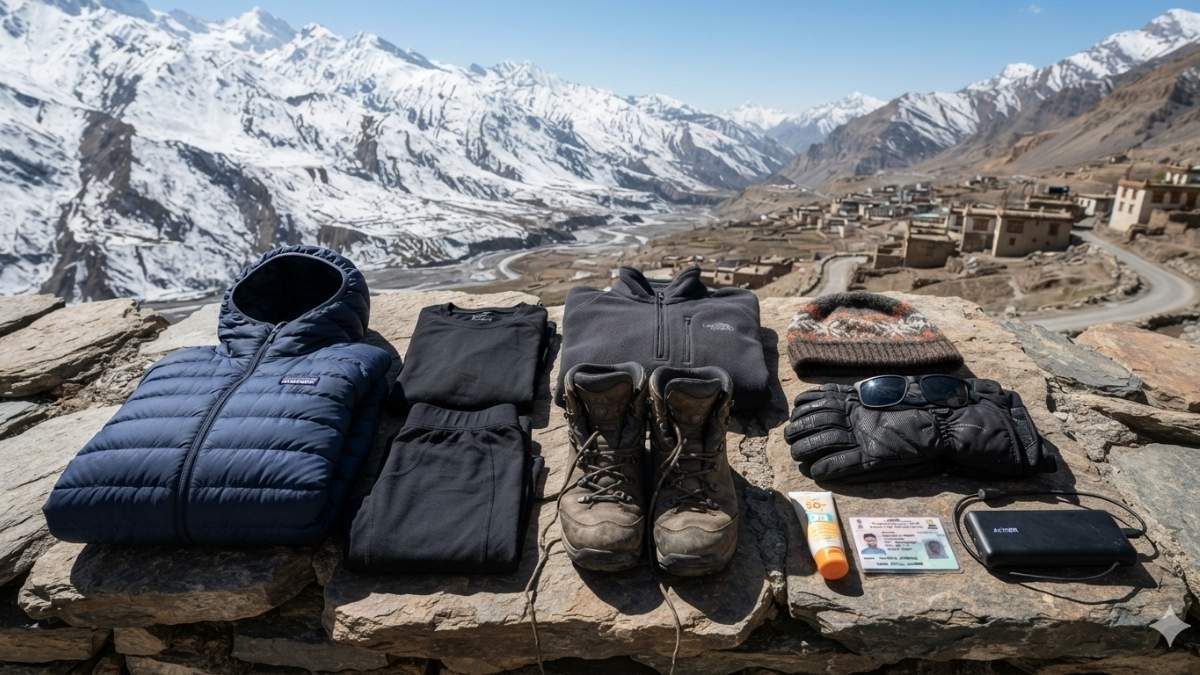
Most people pack for Spiti the way they pack for a hill station. That is the first mistake. Spiti is a cold desert, and Kaza, the main base, sits at about 3,800 metres. You get strong sun and sharp cold on the same day. If you are wondering what to pack for Spiti Valley, this guide gives you a list for summer and for winter, plus the small things people only remember once they are standing in Kaza market.
We, The Travel Story host group tours to Spiti Valley. You meet like-minded travellers and make bonds for life. If you're interested then you can check out our Winter Spiti Expedition is a 6N7D group trip from Delhi that goes in through Shimla and Kalpa, with a trip captain and an oxygen cylinder in the vehicle the whole way. It starts from Rs 17,999 plus 5 percent GST. Check the dates on the trip page and the packing list below will tell you exactly what to bring. Going in summer instead? The Spiti with Chandrataal trip is the one to look at.
Key takeaways
- Spiti is cold at night in every season, even when the sun is strong at noon.
- Winter nights in January and February sit between minus 20 and minus 30 degrees Celsius, so three proper layers is the minimum.
- Carry UV sunglasses, sunscreen and lip balm in every season. The sun at this height burns faster than it feels.
- Withdraw cash before Shimla or Kalpa. ATMs and cards are unreliable after that.
- Carry a power bank, a reusable water bottle and a valid photo ID.
- Avoid cotton as your base layer. Wool or synthetic thermals dry faster and keep you warmer.
How cold does Spiti get, and what should you pack first?

Spiti is cold every month, but the kind of cold changes with the season. The table below shows what each season feels like and the one thing to pack first.
| Season | What it feels like | Pack this first |
|---|---|---|
| June to September | Sunny days, cold nights, sudden shifts in weather | Light down jacket and thermals |
| Late September to October | Clear mornings and chilly weather throughout the day | A jacket within reach, even on a clear morning |
| November | Frequent Snowfall in the villages and temperatures keep dropping | Down jacket and waterproof boots |
| December to March | Nights fall to minus 20 to minus 30 degrees Celsius in January and February | Down jacket rated to minus 10 or colder, thermals, gloves |

Travel sites put summer daytime highs in Spiti at roughly 10 to 22 degrees Celsius, and nights can fall close to freezing early and late in the season.
If you are still choosing your dates, our guide on the best time to visit Spiti Valley explains what each month is really like.
Why does your packing list change along the route?
You do not go from warm to cold in one step. You climb about 3,500 metres from Delhi to Kaza over a few days, and every stop asks for a different layer. As a rough rule, the air gets about 6 degrees Celsius colder for every 1,000 metres you climb. So Kaza can feel 20 degrees colder than Delhi on the same day, before wind and shade make it worse.
| Place | Approx. height | What you will need there |
|---|---|---|
| Delhi | About 220 m | Light clothes for the start of the drive |
| Shimla | About 2,200 m | A fleece or light jacket for the evening |
| Kalpa | About 2,800 m | Thermals and a warm jacket, especially in winter |
| Kaza | About 3,800 m | Full layering, gloves, cap and sun protection |
| Key Monastery, Chandratal, Kibber, Langza | About 4,100 to 4,400 m | Your warmest layer in hand, plus wind protection |
Because of this, do not bury your jacket at the bottom of the bag. Keep one warm layer, your gloves and a cap in a small day pack that stays with you in the vehicle.
What to pack for Spiti Valley in summer (June to September)
Summer packing is about layers you can take off by noon and put back on by evening. Here is the clothing list.
- Light down jacket or a warm fleece
- Thermal top and bottom, one set
- 3 or 4 full sleeve tops (full sleeves protect you from the sun as well as the cold)
- Trousers or track pants, not shorts
- A rain or wind shell, because the approach roads can see heavy rain in July even when Spiti stays dry
- Warm socks and one dry pair kept for the evening
- A cap or hat and a warm beanie for the night
- Light gloves for Chandratal and for early mornings
On our Spiti with Chandrataal trip, the Chandratal night is the coldest night of the trip, and there is no network at the camps. Charge your phone and download what you need before you reach it.
What to pack for Spiti Valley in winter (October to March)
Winter Spiti asks for real cold weather gear, and thermals are not just for evenings. Wear them as a base layer all day. The list below follows our Winter Spiti Expedition trip page.
- Down jacket rated to at least minus 10 degrees Celsius (minus 20 if you feel cold easily)
- Thermal tops and bottoms worn as a base layer through the day
- A fleece or sweater as the middle layer
- Full sleeves and full length bottoms at all times, however mild one afternoon feels
- Warm waterproof gloves and a thick cap that covers your ears
- Woollen socks, and one completely dry pair for sleeping
- Waterproof boots with a good grip
- A scarf or neck gaiter for wind
Winter also changes the rhythm of the day. Shops close well before evening, and in the coldest weeks most cafés in Kaza market do not open at all. Carry some snacks from Shimla so you are not hunting for food at 6 pm.
The three layer system for winter
The simplest way to stay warm in Spiti is three thin layers instead of one thick one. Air trapped between the layers is what keeps the heat in, and you can remove one layer when the sun comes out.
| Layer | What to wear | Job it does |
|---|---|---|
| Base | Wool or synthetic thermals | Keeps sweat off your skin so you do not get cold when you stop moving |
| Middle | Fleece or sweater | Traps body heat |
| Outer | Down jacket, with a wind shell if possible | Blocks wind and holds the warmth in |
One more thing about the base layer: avoid cotton. Cotton holds sweat and stays damp, and damp clothes make you colder at minus 20 degrees. A hoodie or a cotton vest under your jacket is a common reason first timers feel cold even with a heavy jacket.
Which shoes should you take?
Take broken in shoes with a firm grip, and do not wear a new pair for the first time on the trip. Roads in Spiti are rough and you will walk on uneven ground at monasteries and viewpoints. In winter, choose waterproof boots over sneakers, because snow and cold get through canvas fast.
Pack your socks in two groups. One pair is for walking, and one pair stays dry in a zip bag for sleeping. Wet or damp socks are the fastest way to get cold feet at night.

How do you protect yourself from the sun and dry air?
Pack UV protected sunglasses, sunscreen and lip balm for every season. The daytime sun at this altitude is sharp even when the air is freezing, and the air is very dry. A basic moisturiser helps your skin and a cap helps your face.
The reason is simple. UV rays get stronger by roughly 10 percent for every 1,000 metres you climb, and snow reflects more of it back at your face. That is why people in Spiti get sunburnt on a day when they never felt warm. Sunglasses matter even more in winter, when snow glare can hurt your eyes within an hour or two.

What health items should you carry?
Carry your regular medicines and a basic personal medical kit. Pharmacies past Kalpa are minimal, so you cannot count on buying anything later. Altitude affects people in ways that have little to do with fitness. Talk to your doctor before the trip, especially if you have a heart, lung or breathing condition, and do not start any medicine on your own. Our vehicles carry an oxygen cylinder for emergencies.
A few simple habits also help your body at this height. Drink water often even if you do not feel thirsty, walk slowly on the first day in Kaza, and tell your trip captain early if you get a headache or feel unusually tired. At 3,800 metres the air holds roughly 60 to 65 percent of the oxygen you get at sea level, so a slow first day is normal, not a sign of weakness.
What documents, cash and phone things do you need?
Carry a valid photo ID, either Aadhaar or a passport, because checks happen at a few points, including near Sumdo where you enter Spiti. Indian nationals generally do not need an Inner Line Permit for this route. Foreign nationals should confirm the rules before booking.
For money, withdraw cash before Shimla or Kalpa. ATMs run dry beyond that point, and in winter they can be out of service for days. Keep a little cash for meals, personal spending in Kaza and the Chandratal entry fee.
For your phone, BSNL, Jio and Airtel work best, and Vodafone is gone past Kinnaur. Download offline maps, tickets and music before you leave Shimla. A power bank matters because charging is not guaranteed everywhere, and cold weather drains phone batteries faster, so keep your phone inside your jacket.
Keep your power bank and any camera battery inside your jacket too. Cold batteries can show 40 percent and shut down in a minute. Warm them against your body and they often come back to life.

What small things help in cold rooms and cold water?
These are the items that rarely make a packing list but make the nights easier, especially in winter.
- Wet wipes and hand sanitiser: water pipes can freeze in the coldest weeks, so running water is not always available.
- An insulated bottle: a plain bottle can freeze overnight. Keep it inside your quilt, or store it upside down so ice forms at the bottom and not at the opening.
- Toilet paper and a small towel: a quick dry towel is better than a thick cotton one.
- A zip bag or two: they keep dry socks, tickets and your phone safe from damp and snow.
- A small torch or headlamp: power cuts are common in remote villages, and phone torches drain quickly in the cold.
- Lip balm and moisturiser in your pocket: not in the bag in the boot of the vehicle, where they can freeze.
What do people forget most often?
These five things come up again and again. Check them before you zip your bag.
- UV sunglasses and sunscreen
- Cash withdrawn before Shimla or Kalpa
- A power bank
- A reusable water bottle
- A valid photo ID (Aadhaar or passport)

Summer and winter packing list side by side
Use this table as a final check. It shows how the same item changes from one season to the other.
| Item | Summer (June to September) | Winter (October to March) |
|---|---|---|
| Main jacket | Light down jacket or warm fleece | Down jacket rated to minus 10 or colder |
| Thermals | One set, mostly for nights | Two sets, worn all day |
| Gloves | Light gloves | Warm waterproof gloves |
| Head | Cap for the day, beanie for the night | Thick cap that covers the ears |
| Footwear | Broken in shoes with a firm grip | Waterproof boots with a good grip |
| Rain or wind shell | Yes, for July rain on the approach roads | A wind shell helps, a scarf or neck gaiter is a must |
| Sun protection | UV sunglasses, sunscreen, lip balm | UV sunglasses, sunscreen, lip balm |
| Power bank | Yes | Yes, kept inside your jacket |
What should you leave at home?
Leave behind the things that add weight and give nothing back. A hard trolley bag is awkward on stairs and gravel paths, so a soft bag and a small day pack work better. Skip a hoodie as your only warm layer, since a proper jacket over thermals does the real job. Leave single use plastic bottles at home too, because plastic waste is a real problem in Spiti.
Alcohol and smoking are not permitted on our Winter Spiti Expedition. Spiti has less oxygen than most of India, and both make dehydration and breathing trouble more likely.
What does a Travel Story trip already provide?
Our trips cover stays, transport and a trip captain. The stay is in hotels and homestays (and Swiss camps with attached washrooms at Chandratal on the Chandrataal trip). Entry tickets to monasteries and an oxygen cylinder in the vehicle are included. Food that is not part of the fixed plan, personal expenses and mineral water are extra.

Plan your trip
If you want the logistics handled and a captain who knows the route, see the Winter Spiti Expedition or the Spiti with Chandrataal trip. For the route and distances, read our guide on how to reach Spiti Valley from Delhi, and for the wider picture see our Spiti Valley page. Travelling around the holidays? Our Spiti Valley New Year Special covers the busy late December window, so book your stay early.