There are valleys in the Himalayas that draw travellers with polished infrastructure, well-marked trails, and mobile signal at camp. Zanskar Valley is not one of them. Tucked into the Kargil District of Ladakh at elevations ranging from 3,500 to 7,000 metres above sea level, Zanskar sits behind walls of rock, ice, and altitude that have kept it insulated from mass tourism longer than almost anywhere else in the Indian Himalayas. That isolation is its defining quality.
The valley runs roughly north to south, drained by the Zanskar River — a tributary of the Indus — and flanked by ranges that block the monsoon entirely, turning the valley into a cold desert of exceptional clarity. The main administrative centre is Padum, a town of a few thousand residents that functions as the gravitational centre for a region of monasteries, glaciers, sacred peaks, and trekking routes that have been connecting Tibet, Ladakh, and the Himalayan foothills for centuries.
For travelers who want to understand Zanskar Valley before committing to the journey, The Travel Story’s Zanskar Valley expedition covers the full circuit — Shinkula Pass, Phugtal Monastery, Gonbo Rangjon, and Padum.
“Zanskar doesn’t ask for your plans. It asks for your patience.”
Zanskar Valley: Key Facts at a Glance
| Detail | Data |
|---|---|
| Location | Kargil District, Ladakh, India |
| Average Elevation | 3,500–7,000 m above sea level |
| Main Town | Padum (3,657 m) |
| Best Time to Visit | June to September |
| Winter Access | Chadar Trek — January to mid-February |
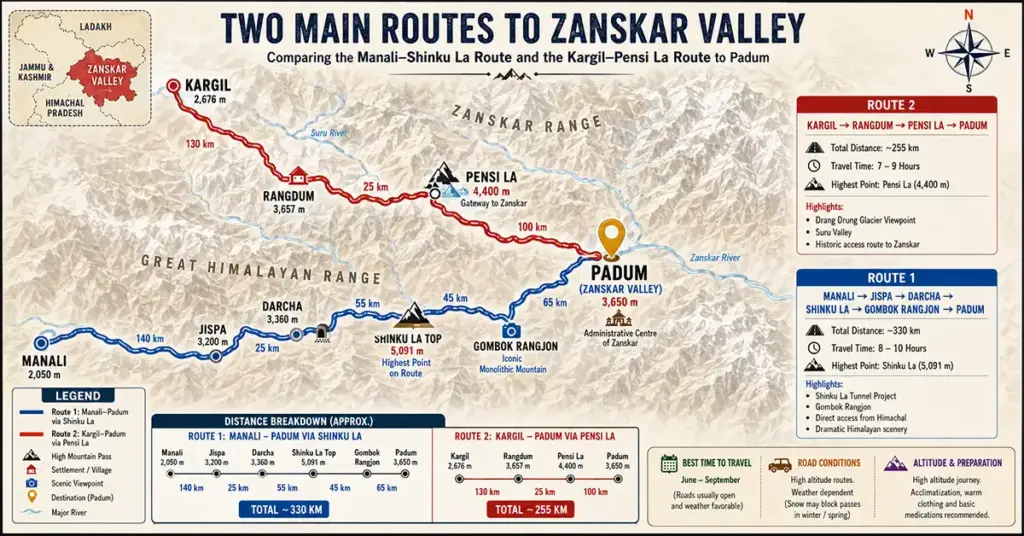
| Key Pass (Manali side) | Shinkula Pass — 5,091 m (16,703 ft) |
| Key Pass (Kargil side) | Pensi La — 4,401 m (14,436 ft) |
| Major River | Zanskar River (tributary of the Indus) |
| Notable Landmarks | Phugtal Monastery, Karsha Monastery, Gonbo Rangjon, Drang Drung Glacier, Sani Lake, |
| Mobile Network | BSNL, Jio and Airtel limited connectivity in the valley |
What Makes Zanskar Valley Different
Most Himalayan destinations offer a gradient and then you move from connected lowlands into progressively wilder terrain, with escape routes at every stage. Zanskar Valley does not operate on that model. There are only two main road exits first one is Shinkula Pass to the south and the other Pensi La to the north — are both high, weather-dependent, and seasonally closed. The valley operates on its own terms.
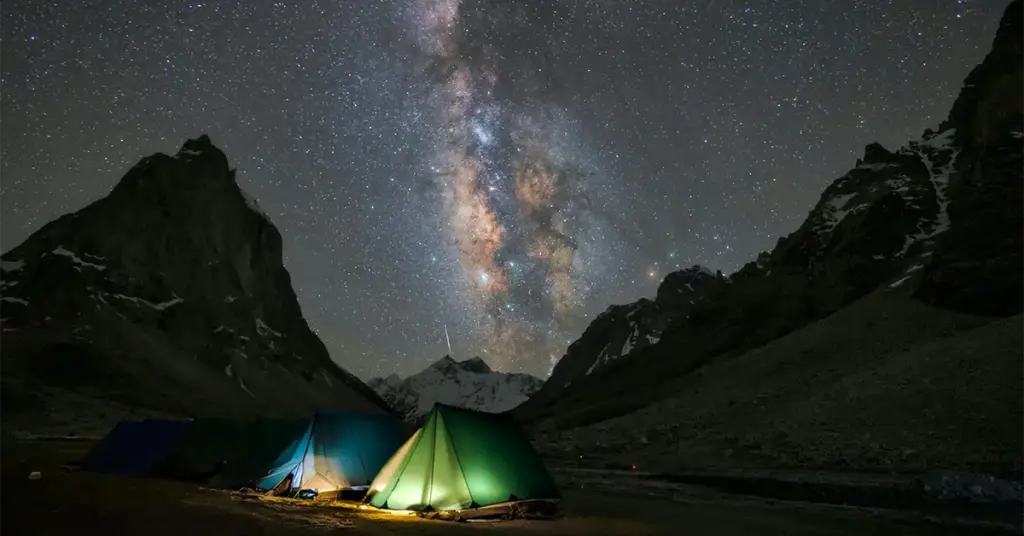
Zanskar forces a kind of commitment that produces a corresponding depth of experience. The monasteries here are not heritage sites maintained for tourism — they are functioning institutions where monks have lived, studied, and practised for centuries without interruption. The villages are not curated for visitors. The landscape is simply what the landscape remianed up until now like brown mountains, glacier-fed rivers of extraordinary colour, and skies that reward the absence of light pollution with a generosity most travellers do not encounter elsewhere.
The Two Routes Into Zanskar Valley
Route 1 — Manali to Gonbo Rangjon via Shinkula Pass
Full route: Manali → Keylong → Jispa → Shinkula Pass (5,091 m) → Lakhang → Gonbo Rangjon → Purne → Padum
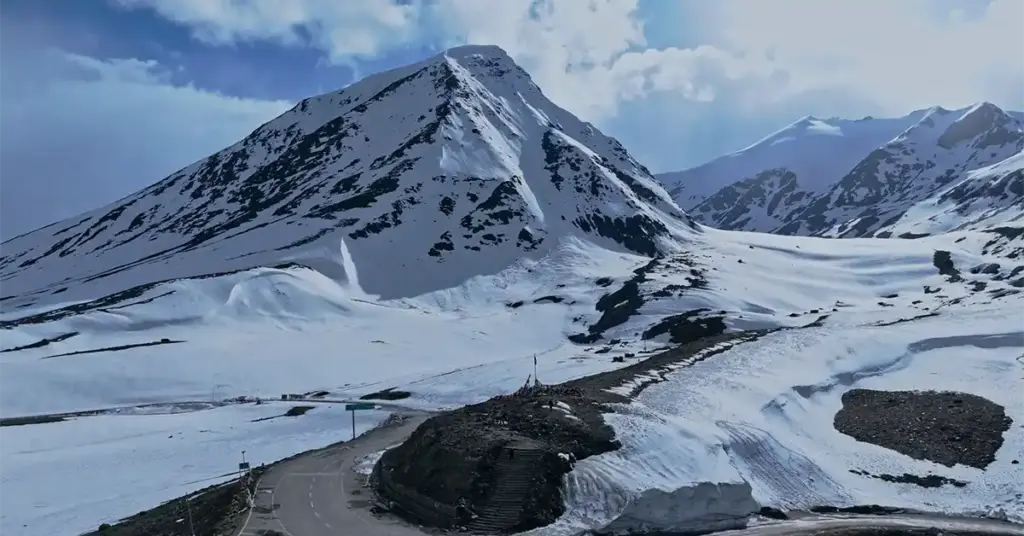
The road climbs through the Lahaul Valley before ascending to Shinkula Pass at 16,703 ft — the highest point on this approach and the gateway into Zanskar from Himachal Pradesh. Shinkula typically opens in late May and closes by mid-November.
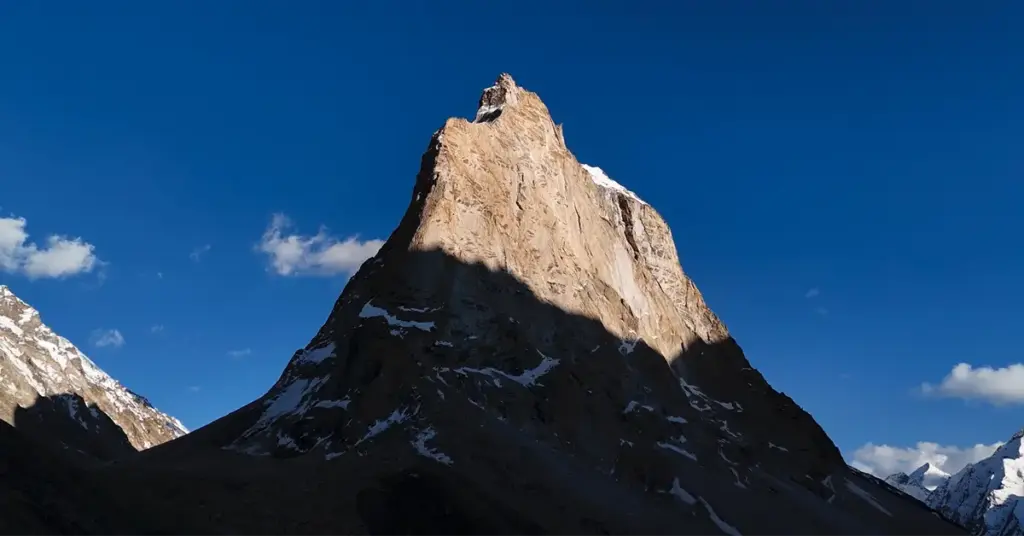
Immediately after descending from the pass, the road reaches the base of Gonbo Rangjon — a solitary, pyramidal sacred peak that rises from the valley floor without the company of surrounding ridges. Locals across Zanskar revere it as a protector mountain; many believe the cliff face carries the image of the Buddha. It marks the psychological entrance to Zanskar as much as the geographical one.
The road continues through Kargiakh — the first village of Zanskar — past Muney Monastery and Bardan Monastery, before reaching Purne and then Padum.
- Distance from Manali to Padum: ~360 km
- Driving time: 2 days with overnight in Jispa
- Road type: Tarmac to Shinkula, mix of gravel and loose surface into Zanskar
Route 2 — Kargil to Gonbo Rangjon via Suru Valley and Pensi La
Full route: Srinagar → Sonmarg → Zoji La → Kargil → Suru Valley → Rangdum → Pensi La (4,401 m) → Padum → Gonbo Rangjon
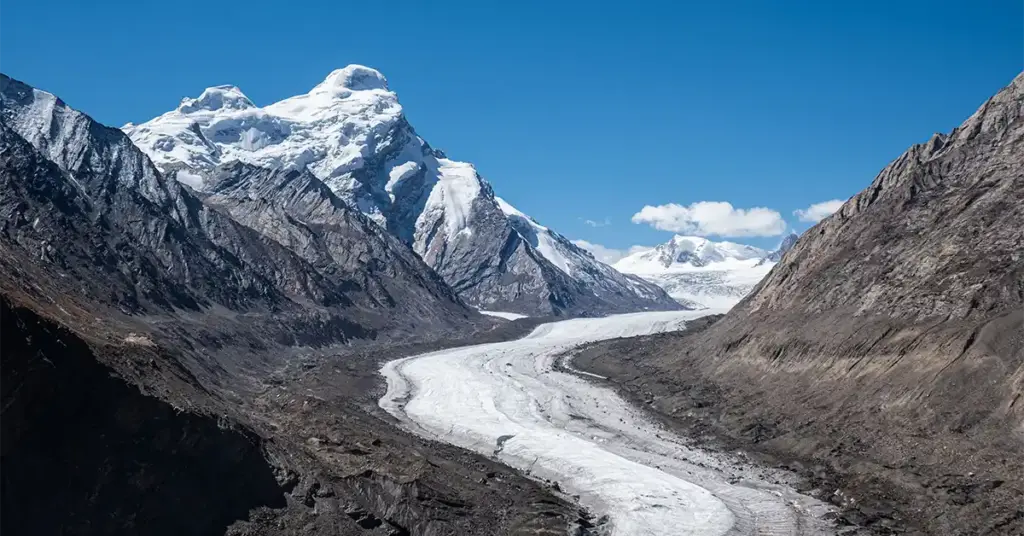
The Suru Valley approach offers a different landscape from the Manali route — green lower valleys that harden progressively into cold desert terrain as the road climbs toward Rangdum. Before Pensi La, the road passes the Drang Drung Glacier — approximately 23 km long, it is one of the largest glaciers in the western Himalayas and the only glacier in India accessible directly by road. The twin glacial lakes of Stat Tso and Lang Tso sit at the pass itself.
From Padum, the road to Gonbo Rangjon heads south through Purne toward the mountain’s base.
- Distance from Kargil to Padum: ~230 km
- Driving time: 1 full day; overnight in Rangdum recommended
- Road type: Mix of tarmac and gravel; Pensi La section is unpaved
The Landmarks That Define Zanskar Valley
Phugtal Monastery — Lungnak Valley
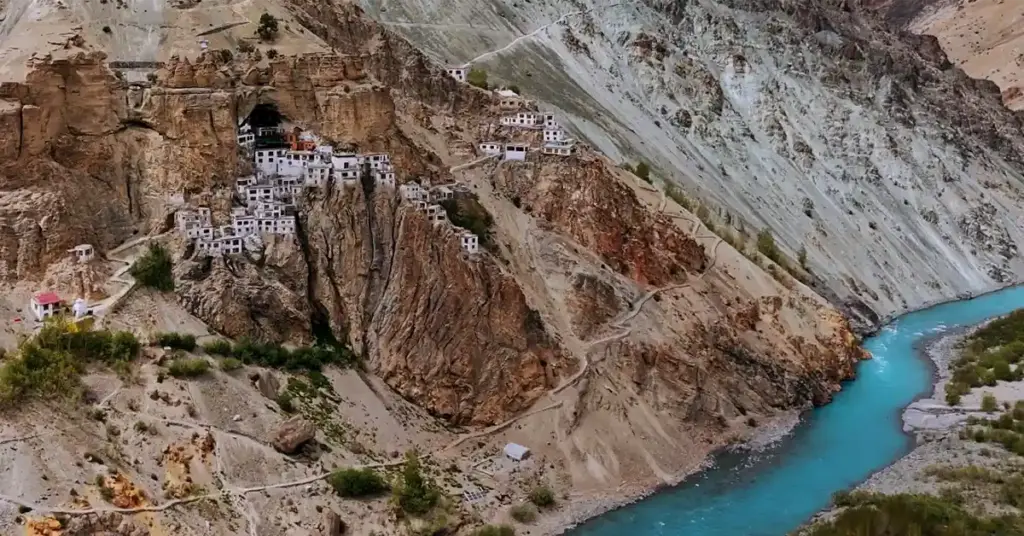
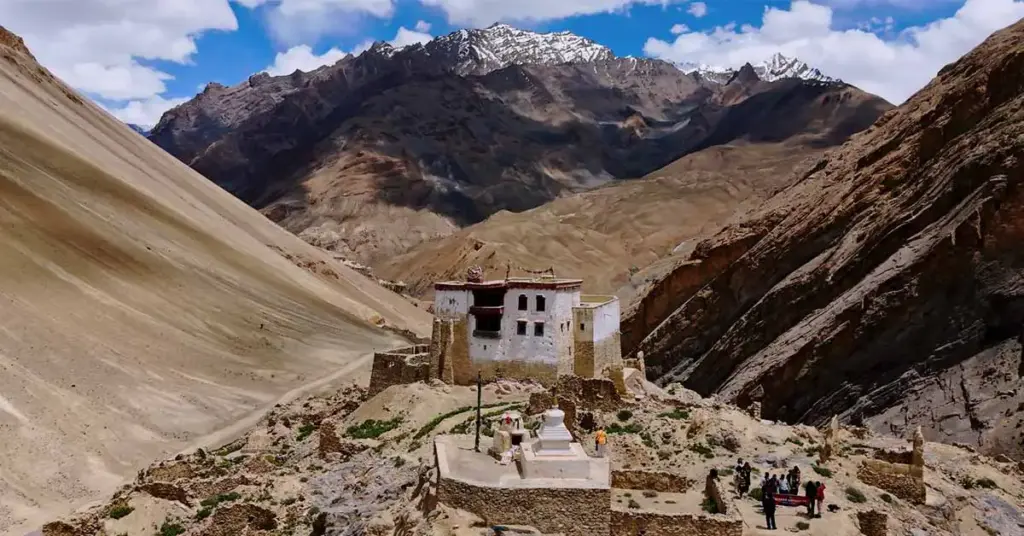
Built into the cliff face of the Lungnak Valley in southeastern Zanskar, Phugtal is among the most visually extraordinary religious sites in the entire Himalayan region. The complex is constructed inside and around a natural cave — the structure extends outward from the rock face in tiers, resembling what many visitors describe as a honeycomb pressed into a cliff.
Until the Nimmu-Padum-Darcha (NPD) road was completed in 2022, Phugtal was reachable only by multi-day trek. Today, the trailhead at Purne is road-accessible; the monastery requires a 1.5 to 2-hour hike along the turquoise waters of the Tsarap River. The colour shifts from deep teal to glacial blue depending on the season and light — a consistent feature of every account of the approach.
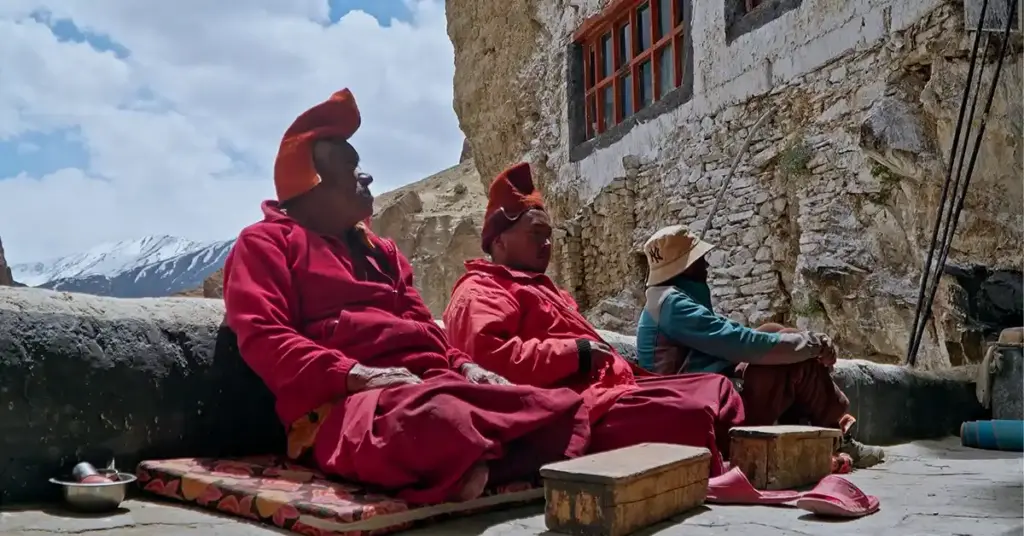
The monastery is an active centre of Tibetan Buddhist scholarship. Visitors are welcome and should remove footwear at the entrance, maintain silence in prayer halls, and seek explicit permission before photographing monks or ceremonies.
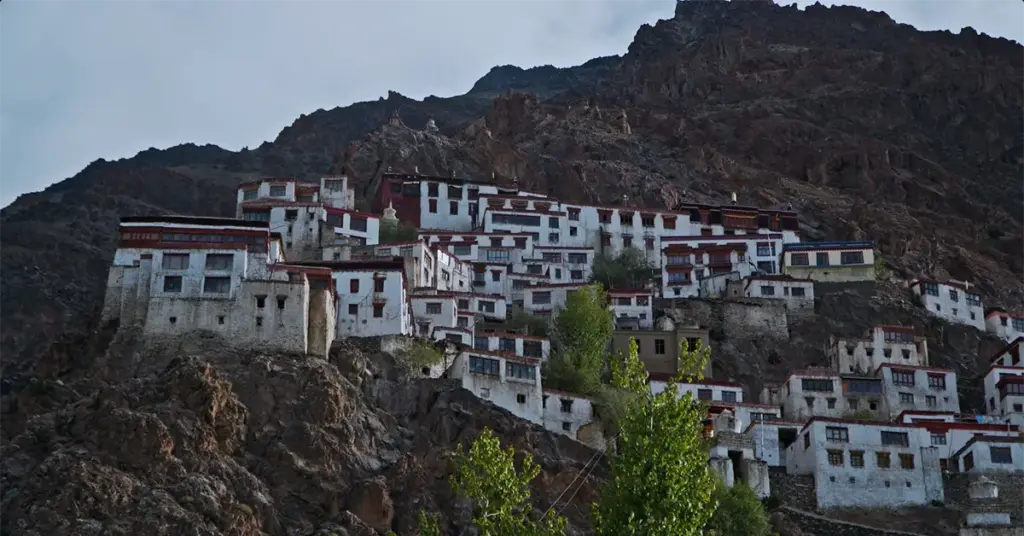
Karsha Monastery — Above Padum
The largest monastery in Zanskar Valley, Karsha dates to the 10th century and sits on a hillside above the Stod River near Padum. Its whitewashed walls, ancient murals, and position make it the most visited religious site in the valley. The annual Karsha Gustor festival — typically held in July or August — draws the entire regional community and is one of the most significant cultural events in Zanskar’s calendar.
Gonbo Rangjon — The Solitary Sacred Peak
Unlike the peaks that form the valley walls, Gonbo Rangjon rises as a standalone formation — a pyramid of rock with no mountain neighbours, rising dramatically from the valley floor near Ating village. Its placement along the main trail from Shinkula into Zanskar makes it unavoidable on the Manali approach. Travelers report that even a thirty-minute stop at its base produces a disproportionate impression.
Drang Drung Glacier — Near Pensi La
At approximately 23 km long, Drang Drung is the source of the Stod River and one of the most accessible glaciers in the western Himalayas. Visible from the road near Pensi La, it descends from the peaks in a scale that most photographs underrepresent. The fact that no trekking or additional travel is required to see it makes it one of the most underrated stops on the Kargil-to-Padum route.
Stongdey Monastery — Above the Lungnak Valley
Stongdey Monastery sits on a rocky outcrop above the Lungnak Valley, approximately 20 km from Padum, and is the second largest monastery in Zanskar after Karsha Monastery. The monastery is accessible by road from Padum. The drive takes under an hour and the climb from the road to the monastery entrance is steep but short. From the top, the view across the Lungnak Valley is one of the cleaner panoramas available without a full trekking day.
Zangla Palace — Above Zangla Village
Zangla Palace is the former seat of the Zanskar royal family, perched on a hilltop above Zangla village on the northern bank of the Zanskar River, roughly 40 km northeast of Padum. The royal family of Zanskar still maintains a presence in the area, and the village below the palace has a small monastery connected to the palace’s history.
Adventures in Zanskar Valley
The Chadar Trek — January to February
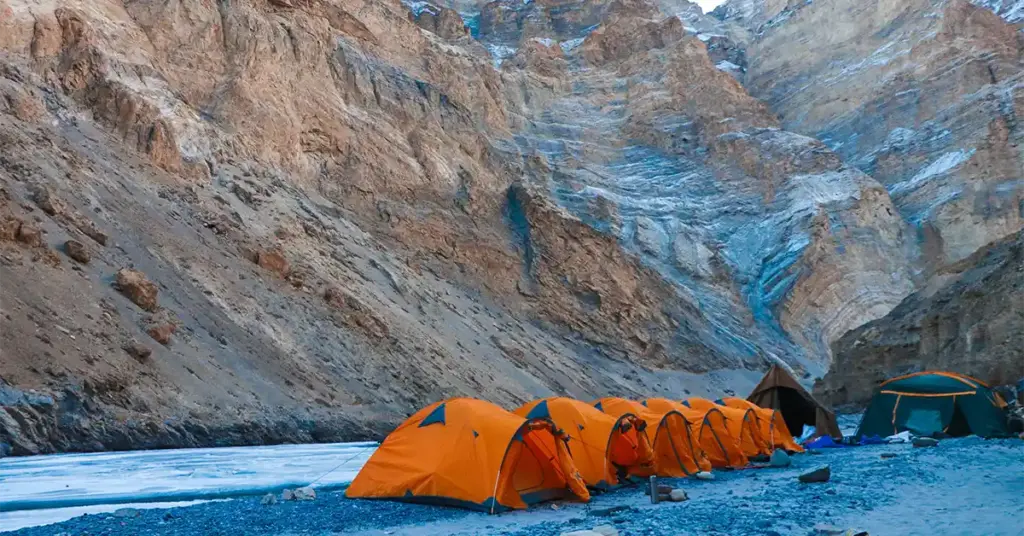
The Chadar Trek follows the frozen surface of the Zanskar River through its deep canyon — historically the only winter connection between Zanskar and the outside world. Temperatures drop to -30°C or below; the ice surface changes daily; sections can crack or partially melt without warning.
Duration: 9–10 days from Leh Difficulty: High — cold management and physical endurance both required Key note: The 2022 NPD road has altered some traditional Chadar Trek sections. Verify accessible stretches with a local operator before booking — the classic end-to-end route is no longer consistently available.
Lamayuru–Padum Trek
A 7–10 day crossing from Lamayuru Monastery in northern Ladakh to Padum, over the Singe La and Hanuma La passes. The route passes through remote villages that see very few non-local travellers. It is one of the most complete wilderness trekking experiences in the western Himalayas.
Zanskar River Rafting
The lower Zanskar River, from Padum toward its confluence with the Indus near Nimmu, offers class III–IV whitewater through canyon walls hundreds of metres high that are inaccessible by road. Most rafting expeditions run 4–6 days.
Best Time to Visit Zanskar Valley
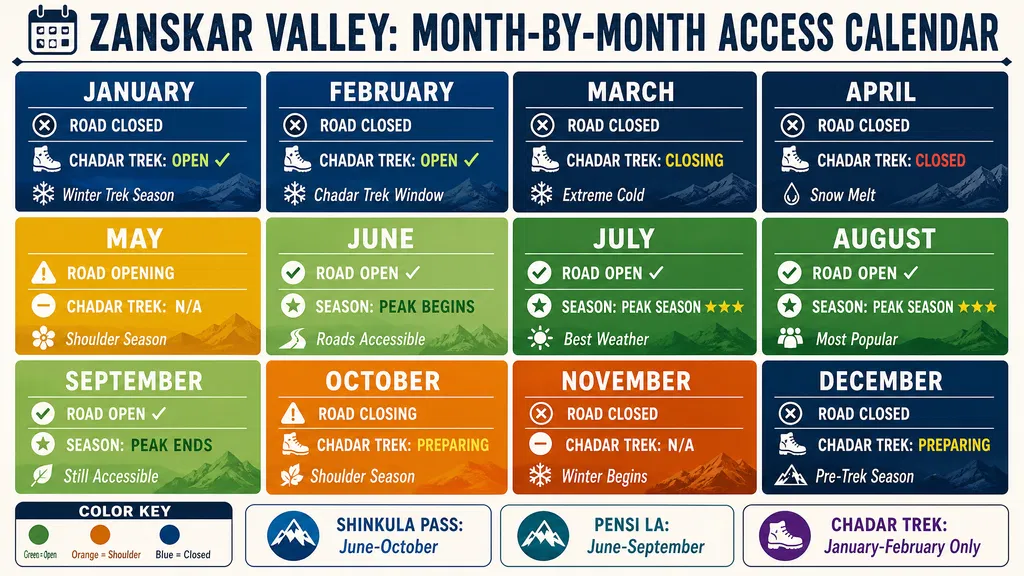
Summer Season (June to September)
Summer is the primary tourist season in Zanskar Valley. During these months, the roads are open, weather is relatively stable, and temperatures range from 10-15°C during the day. June and early July see the valley recovering from winter, with patches of snow still visible on higher elevations. By August and September, the weather stabilizes, making these the ideal months for trekking and general tourism.
Real-world example: Most organized tours and trekking expeditions operate during July and August, when weather conditions are most predictable and daylight hours are longest.
Winter Season (December to February)
Winter transforms Zanskar Valley into a frozen landscape. The Chadar Trek, the famous frozen river trek, is only possible during this season. However, winter travel requires specialized equipment, experience, and careful planning. Temperatures drop to -40°C, and the valley becomes completely isolated.
Shoulder Seasons (May and October)
May and October offer transitional weather. May sees the valley awakening from winter, with some roads still challenging. October marks the beginning of winter preparations, with weather becoming increasingly unpredictable.
Practical Travel Tips for Zanskar Valley
Cash and fuel
- Last reliable fuel: Kargil (northern route) or Keylong (Manali route)
- Nearest ATM: Kargil — no ATMs function in Padum or surrounding villages
- Carry minimum ₹3,000–5,000 cash per person for a 4–5 day valley stay
Connectivity
- Only postpaid SIMs work in Zanskar Valley — prepaid SIMs of any network do not function BSNL postpaid has the widest coverage; most reliable option in Padum and surrounding villages
- Jio postpaid and Airtel postpaid have limited but functional coverage in Padum — signal drops significantly beyond the town
- No Wi-Fi in guesthouses across the valley
- Plan for 5–6 days of effectively offline access outside Padum
Altitude
- Padum sits at 3,657 m; passes exceed 5,000 m
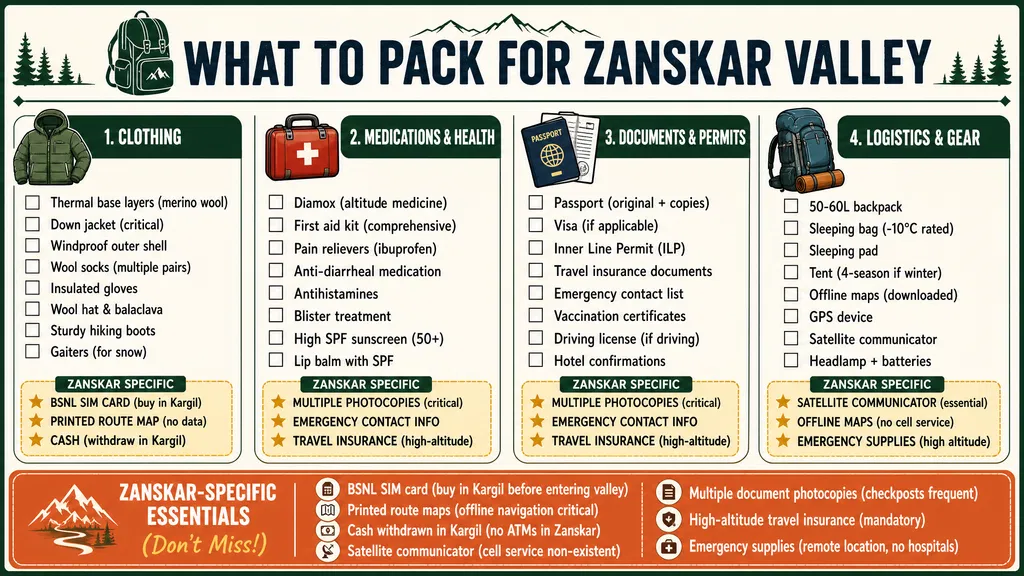
- Carry Diamox (Acetazolamide) — consult a doctor before the trip, not at a pharmacy en route
- Build one acclimatisation day into the itinerary before high-pass crossings
Gear
- Windproof, waterproof outer layer — mandatory even in summer
- Thermal base layers for nights (temperatures drop below 5°C consistently)
- Trekking shoes with ankle support for monastery hikes
- SPF 50+ sunscreen, UV sunglasses, lip balm
- Filter bottle
Medical
- Basic district hospital in Padum — emergency use only
- Nearest full-service hospital: Kargil (~230 km)
- Travel insurance with helicopter evacuation coverage is strongly recommended
Local Culture in Zanskar Valley
Zanskar is Tibetan Buddhist in every dimension from language, architecture, daily rhythm, to festival calendar. The valley was not significantly influenced by outside governance until the 20th century, and its cultural continuity is among the most intact of any Himalayan valley in India.
- Remove footwear before entering any monastery or home — without exception
- Ask explicit permission before photographing monks, elderly residents, or religious ceremonies
- Attend festivals if timing allows: Karsha Gustor, Sani Nasjal, and Phugtal Gustor draw the entire community
- Buy from local guesthouses and village markets — the valley economy runs on a short seasonal window
- Match the pace of local life; visitors who do have more meaningful interactions
“The monasteries of Zanskar were not built for tourists. They were built for eternity. Visit accordingly.”
FAQs About Zanskar Valley
Indian nationals do not need a special permit for Zanskar Valley. Foreign nationals require an Inner Line Permit (ILP), available online or from district offices in Leh or Kargil. All travellers should carry multiple photocopies of government-issued ID — checkposts on all entry routes check documentation regularly.
June to September is the primary travel window — both the Manali and Kargil routes are open, weather is stable, and the landscape is at its most accessible. September offers the clearest skies and most reliable roads. The valley is effectively cut off from November to May.
From Delhi: overnight bus or flight to Manali → one night in Jispa → Padum via Shinkula Pass (one full driving day). Alternatively: flight to Leh or Srinagar → Kargil → Padum via Suru Valley and Pensi La. There are no flights into Zanskar; the nearest airports are Leh (Kushok Bakula Rimpochee) and Srinagar.
The Nimmu-Padum-Darcha road, completed in 2022, has altered portions of the traditional Chadar Trek. Some sections remain intact; others have been affected by road construction. The classic end-to-end frozen river walk is no longer consistently available. Verify current conditions with a local operator before booking.
The nearest functioning ATM is in Kargil. UPI and card payments are not reliable due to absence of mobile connectivity. Carry enough cash from Kargil or Manali for your full valley stay, including emergency buffer.
Padum has guesthouses, small hotels, and homestays. Purne, Karsha, Rangdum, and villages along main trekking routes offer basic homestay accommodation. There is no luxury or resort-category accommodation anywhere in Zanskar Valley.
Yes, with preparation. Personal safety is not the primary concern — altitude, weather, and road conditions are. Solo travellers without a satellite communicator are significantly more exposed on remote sections. A SPOT or Garmin inReach device is a practical investment for anyone travelling independently.
The valley and surrounding terrain support snow leopards, Himalayan ibex, bharal (blue sheep), Tibetan wolves, marmots, lammergeier, and golden eagles. Snow leopard sightings are rare but documented in winter months. Ibex and bharal are more reliably spotted at higher elevations above 4,000 m.
Conclusion
Zanskar Valley does not compete for visitors — and does not need to. The short access window, high passes, absent infrastructure, and the cultural depth that takes more than a day to absorb act as a natural filter. Travelers who make it to Padum are, almost by definition, the ones who were prepared to make it there.
The valley rewards that preparation with genuine remoteness and cultural continuity that most destinations can no longer offer. Phugtal Monastery built into its cliff face, Gonbo Rangjon rising alone from the valley floor, the Drang Drung Glacier visible from the road, the Zanskar River running turquoise through a gorge that no road enters — these are not manufactured experiences. They require arriving informed, arriving with the right gear, and arriving with enough time.
For travelers who want a structured circuit covering the full route from Shinkula Pass to Phugtal, Gonbo Rangjon, and Padum, The Travel Story’s Zanskar Valley package runs batches from June through September.
“There are places on this planet where the land is older than your questions. Zanskar Valley is one of them.”
Salman Hashmi is a travel industry expert, group travel leader, and destination specialist with over 3 years of hands-on experience in travel operations, trip management, and destination planning across India now working as a Marketing Executive. His expertise extends beyond leading trips on the ground to managing the critical backend logistics that ensure seamless travel experiences, including itinerary planning, vendor coordination, traveler support, and operational execution.
Over the years, Salman has successfully organized and led group tours to destinations such as Spiti, Kashmir, Tirthan-Jibhi, Jaisalmer, Shangarh, Chopta-Tungnath, Auli, Chakrata, Badrinath, Valley of Flowers, Udaipur, Harsil Valley, and many more. His extensive field experience provides deep insights into local cultures, regional traditions, historical landmarks, and destination-specific travel experiences. Through continuous exploration and interaction with local communities, he has developed a strong understanding of India’s diverse history, heritage, and cultural landscapes.
In the past, Salman has collaborated with and hosted well-known content creators including Richi Shah, TheMaahie, and Trahuller, while managing travel experiences for more than 700 travellers. His combination of on-ground leadership, operational expertise, destination knowledge, and understanding of local history and culture enables him to create trustworthy, experience-driven travel content that helps readers make informed travel decisions with confidence.